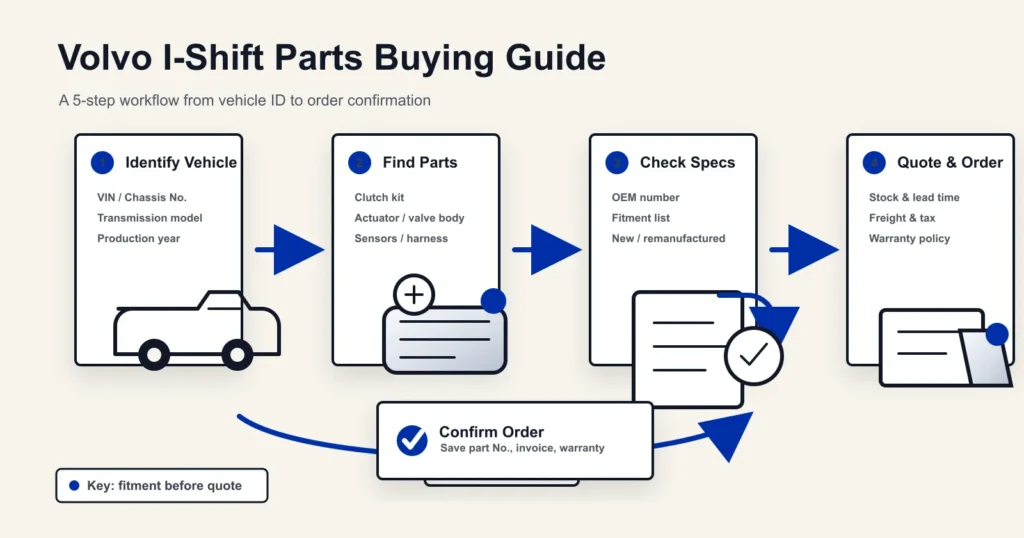
A reliable Volvo I-Shift parts request starts with evidence from the installed transmission and original component. Record the complete gearbox model and suffix, photograph the nameplate and serial information, capture any OEM or part number exactly as marked, and provide clear old-part photographs. Add the required quantity and destination country. The truck model or VIN can support the review, but neither should be treated as proof of exact part fitment.
This buying guide is for importers, distributors, transmission rebuilders, repair networks, fleets and industrial procurement teams. It explains how to prepare a qualified parts inquiry and compare a quotation. It is not a repair tutorial, a universal compatibility chart or a replacement for the Volvo Transmission Hub.
What buyers should send first
Before discussing a specific product, prepare:
- Complete gearbox model and suffix.
- Full nameplate and serial photographs.
- OEM or part number exactly as shown, with a source photograph.
- Old-part photographs from several angles.
- Any requested dimensions, with units and measurement method.
- Truck model and VIN as supporting context.
- Required quantity.
- Destination country.
- A note identifying unreadable, missing or conflicting information.
If the evidence is incomplete, label the request as requiring verification. Do not select a part by product name or truck model alone.
What “I-Shift parts buying” means
For procurement purposes, an I-Shift parts request combines transmission identification, part identification, commercial requirements and a compatibility review. A concise system overview may help buyers describe an inquiry, but technical explanation belongs on the Understanding Volvo I-Shift Transmission page.
VT/VTO and I-Shift must not be treated as the same transmission family. Verify the family from the complete gearbox designation and nameplate before following an I-Shift-specific buying path. That classification still does not confirm individual component fitment.
Which identifier should guide the inquiry?
| Identifier | What it supports | What it does not confirm alone |
|---|---|---|
| Complete gearbox model and suffix | Narrows the unit family and variant for review | Exact component fitment |
| Nameplate and serial information | Connects the request to the installed unit | Interchange with another unit |
| OEM or part number | Creates a traceable matching reference | Supersession, cross-reference or current supply |
| Old-part photographs | Supports comparison of visible design and markings | Internal specification or hidden compatibility |
| VIN and truck details | Adds vehicle and original-build context | The exact unit or component currently installed |
| Product-page record | Helps discover a possible product group | Verified OEM, fitment, stock or warranty |
Use several identifiers together. If they conflict, stop and request a compatibility review rather than choosing the most familiar number.
Why the complete gearbox suffix matters
A partial gearbox designation may identify a broad family but omit information needed to review a variant. Copy every character, separator and suffix from the installed unit. Photograph the source so the supplier can check transcription.
A suffix should never be used as a shortcut to a universal fitment conclusion. It is one input in the evidence set.
OEM or part number versus part name
A part name such as “gear,” “shaft,” “synchronizer component” or “repair kit” describes a category, not a unique orderable item. An OEM or part number can provide a stronger reference, but the number must be recorded from a traceable source.
Do not assume that:
- Similar-looking numbers are interchangeable.
- A casting mark is an orderable number.
- A product listing proves the number is verified.
- One part number fits every gearbox sharing a broad model name.
- A historical reference proves current availability.
Submit the number with its photograph and ask what evidence supports the proposed match.
Select the part group before selecting a product
The buyer can use visible evidence and the repair scope to describe the required group. The supplier or rebuilder must still verify the exact item.
| Inquiry group | Useful buyer evidence | Procurement boundary |
|---|---|---|
| Gear or shaft component | Markings, tooth/spline views, key dimensions if requested, gearbox designation | Do not infer material, dimensions or fitment from appearance |
| Synchronizer-related component | Full component views, markings, related gearbox evidence | Do not assume every component in a family is interchangeable |
| Actuation or control-related component | Label/marking, connector views, installed position and unit data | Do not infer software or electrical compatibility |
| Bearing, seal or small component | Marking, dimensions if requested, removal position and unit data | Do not select by generic name alone |
| Housing or casing-related component | Casting/part markings, full exterior and mounting views, damage location, gearbox designation | Do not infer interchange, material or machining specification from appearance |
| Repair kit | Intended repair scope, gearbox evidence and requested contents | Kit contents and fitment require written confirmation |
| Larger assembly | Complete unit evidence, scope, condition requirement and destination | Availability and configuration require quotation review |
These are inquiry categories, not a statement that any particular item is currently supplied or compatible.
How to handle a cross-reference
A cross-reference is a claim that one reference can replace or correspond to another. It must not be accepted from shared wording, a similar number or an unverified listing.
For each proposed cross-reference, ask for:
- Source reference and proposed replacement reference.
- Evidence that both identify the same component scope.
- Gearbox model and suffix to which the review applies.
- Any required dimensional, connector or configuration checks.
- Written confirmation of the exact claim included in the quotation.
If the evidence is unavailable, keep the status as “reference to verify.” Do not publish or order it as confirmed interchange.
Single part, repair kit or assembly?
This is a procurement decision that should follow inspection and scope definition. It is not a diagnosis that can be made from a generic web article.
| Purchase scope | Questions for the buyer and rebuilder |
|---|---|
| Single component | Has the required component been identified from markings, dimensions and unit evidence? |
| Repair kit | Are the required contents listed, and has the kit been matched to the exact gearbox evidence? |
| Larger assembly | Are the configuration, included items, condition category and documentation requirements written in the quotation? |
Do not assume that a kit contains every needed item or that a larger assembly is the correct remedy. Confirm the repair scope with the responsible technical team.
Common mistakes when ordering Volvo I-Shift parts
Relying on the truck model or VIN alone
Vehicle data is useful context, but repairs and replacements may change what is installed. Use evidence from the actual transmission and old part.
Omitting the gearbox suffix
A shortened designation can leave the variant unresolved. Record the complete code.
Sending a typed number without its source
A transcription error or unidentified casting mark can redirect the entire matching process. Send the image.
Assuming VT/VTO and I-Shift are the same family
They must be treated as different families. Establish the family before using an I-Shift buying workflow.
Treating a product listing as fitment evidence
A published record supports discovery only. It does not prove verified OEM, interchange, current stock or compatibility.
Ordering a repair kit without confirmed contents
State the required repair scope and request a written contents list and compatibility review.
Asking for commercial terms before identification
Stock, MOQ and lead time cannot be meaningfully confirmed until the requested item, quantity and destination are sufficiently defined.
Compare quotations using written evidence
A useful quotation should distinguish confirmed information from items still requiring review.
| Quotation field | What to check |
|---|---|
| Product identity | Exact description and reference used for the match |
| Matching basis | Gearbox model/suffix, nameplate, part number and photos reviewed |
| Quantity | Requested and quoted units |
| Condition/category | Precisely described without unsupported quality claims |
| Included items | Especially important for kits and assemblies |
| Packaging | Method and labeling agreed for the order |
| Documentation | Only documents explicitly available for the order |
| Stock and MOQ | Confirmed at quotation |
| Lead time | Confirmed at quotation |
| Warranty | Confirmed in quotation or contract |
| Delivery terms | Written destination and agreed commercial terms |
Do not treat a large online catalog as proof of current supply. A product record and an order-specific quotation serve different purposes.
From buying research to product sourcing
Use the Volvo Transmission Hub as the primary commercial route. After identification, buyers may browse Volvo Transmission Parts as discovery records. For a deeper evidence-collection workflow, use the Volvo transmission identification guide. Buyers researching synchronizer-related components can also review the synchronizer-ring guide without treating it as fitment proof.
Request a compatibility review and quotation
Send a structured RFQ through the contact page with:
- Complete gearbox model and suffix.
- Nameplate and serial photographs.
- OEM or part number with its source image.
- Old-part photographs and any requested dimensions.
- Required purchase scope and quantity.
- Destination country.
- Any uncertainty or conflict in the evidence.
- Packaging or documentation requirements that must be confirmed.
Compatibility, product identity, stock, MOQ, lead time, warranty and other commercial terms require written confirmation. No product-page record alone confirms them.
Procurement FAQ
Is a truck VIN enough to order an I-Shift part?
No. It can support the review, but it does not prove the exact gearbox or component currently installed. Submit actual transmission and part evidence.
Why is the complete model suffix important?
The suffix is part of the full gearbox designation and may help distinguish variants. It does not confirm component fitment by itself.
Can an OEM cross-reference be assumed from a product listing?
No. A cross-reference requires evidence for the exact references and application under review.
How should a buyer request a repair kit?
State the repair scope, submit the gearbox evidence and request a written contents list. Kit contents and compatibility must be confirmed.
When are stock, MOQ and lead time confirmed?
They are confirmed during quotation after the requested item, quantity and destination are sufficiently defined.
What information is required for an international quotation?
Provide the complete evidence set, quantity, destination, purchase scope and any packaging or documentation requirements. Mark all uncertain information clearly.