Packing and Storage
Rotate stock on a first-in, first-out basis and keep the desiccant fresh. An injector that has sat in a humid store for a year can corrode internally even with caps fitted.
Do not store injectors loose in a parts bin. A nozzle that has been knocked against another part can be visually perfect and still leak or spray off-pattern. Keep the original tube until the unit is fitted.
Injectors are precision hydraulic parts. They ship in individual protective tubes with caps on the inlet and nozzle, and with VCI protection for sea freight. A nozzle that has been knocked can be visually perfect and still leak. Store them upright, away from humidity, and never remove the caps until the moment of fitting.
Removal and Installation Pitfalls
XPI injectors sit in a bore that sees combustion heat and carbon. Pulling one without cleaning the bore first drags carbon through the seal area and damages the seat. Use the correct puller, keep the injector straight, and cap the bore immediately. On installation, the hold-down clamp and bolt must be clean and torqued in the specified sequence; a cocked injector leaks combustion gas and overheats the tip.
Replace the injector seals and the high-pressure connector every time. A re-used connector can leak at rail pressure, and a leak there is a fire risk, not just a performance problem. Check the rail and lines for metal debris after a failed injector; debris from a worn pump can destroy a new set within minutes.
What Rail Pressure Data Tells You
Live data separates an injector problem from a supply problem. If commanded and actual rail pressure track closely at idle but diverge under load, the pump or the pressure control valve may be the limit. If pressure collapses quickly after shutdown, an injector or the control valve is leaking internally. If one cylinder shows a high contribution correction while the others are normal, that injector is the first suspect.
Record the data before removing parts. A cylinder balance test on a warm engine, at idle and under load, is the cheapest diagnostic in this category and gives the bench test a baseline to compare against.
Core Return and Warranty
Reman injectors carry a core charge. Return the old unit complete, with the connector and the label intact; a missing label or a butchered connector reduces or voids the credit. Keep the bench sheet and the injector serial with the invoice so a warranty claim can be matched to the unit that failed.
Building a Bench Test Plan
A useful bench plan has a fixed sequence: external clean and leak check, back-leakage at low and high pressure, delivery at idle, delivery at full load, pre-injection quantity, then a spray pattern check. Running the tests in a different order, or skipping back-leakage because it takes longer, is how a marginal injector passes and comes back as a comeback.
Use calibrated test oil, hold the specified temperature, and record ambient conditions. Compare results with the OEM test specification for the exact part number, not with a neighbouring number in the same family. A 2897320 and a 4384363 may share a platform but not a flow curve.
Sourcing and Quality Inspection from Volgen Power
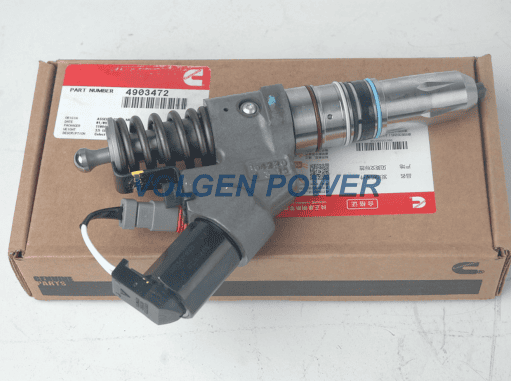
Volgen Power supplies Cummins fuel-system parts through the Shiyan commercial vehicle supply chain. For injectors the inspection points are identity, bench data and packing, because those three decide whether the unit performs in the engine.
- Number and suffix check. Base number, reman suffix and platform confirmed against the ESN and CPL.
- Bench record. Delivery and back-leakage data supplied with the unit on request.
- Label and serial. Checked against the part number; no over-printed or missing labels.
- VCI and shock packing. Individual tube, caps and desiccant for sea freight.
Related reading: Cummins engine parts · Cummins ESN and CPL identification · Cummins 4903472 injector (ISM/QSM family)
Injector or Pump? A Quick Split
When rail pressure is low, the injector is only one suspect. Disconnect the injector return lines one at a time with the engine idling and watch the return flow; a sudden change isolates the leaking unit. If every injector returns excessive fuel, or pressure collapses with the injectors isolated, the pump or the pressure control valve is the more likely cause.
Metal in the rail is the other decisive sign. If the filter or the rail shows fines after a pump failure, replacing injectors without flushing the system will destroy the new set. Flush the rail and lines, replace the filter, and verify cleanliness before fitting new units.
Frequently Asked Questions
How do I know if my XPI injector is failing?
Look for hard starting, a rail that will not hold pressure, a misfire when hot, or a derate. Bench back-leakage above the limit with correct delivery points to an eroded control-valve cone.
Can I use a 4088665 injector in a CM2350 engine?
No. 4088665 belongs to the earlier EPA07 HPI system. The XPI platform uses 2897320, 4384363, 5579419 and related numbers; mixing them will not run correctly.
Why must the trim code be programmed?
The code tells the ECM how that individual injector flows. Without it the ECM applies the wrong correction, causing rough running, smoke and uneven cylinder balance.
What tests should a supplier provide?
Delivery at full load, idle and pre-injection, plus back-leakage, with the test temperature and the injector serial. A delivery-only sheet misses the most common failure.
How can I spot a counterfeit injector?
Check the label against the box, look for over-printed numbers, missing serials, unusually low prices and a seller who cannot supply bench data. Genuine reman units come with a defined exchange route.
Need an XPI Injector Matched to Your ESN?
Send the engine serial, CPL, the old injector number and its trim code. We will confirm the correct XPI reference, state whether it is new or reman, and provide the bench data for the unit being shipped.
WhatsApp our parts desk: +86 188 7263 0128 — include ESN, CPL and quantity.
Trim Code and Programming
Each XPI injector carries a trim code (also called an IQA or correction code) that tells the ECM how that individual injector actually flows. Fitting an injector without programming its code leaves the ECM using the old correction, which produces rough running, smoke and uneven cylinder balance. On some engines the code is on a label; on others it must be read from the injector with a diagnostic tool.
- Record the old trim code before removal when the engine still runs.
- Program the new code with the diagnostic tool after fitting.
- Clear faults and run a cylinder balance check.
- Record the injector serial and code in the service file.
Counterfeit and "Rebuilt" Injectors

For injector diagnostics on the earlier M11/ISM family, our Cummins M11 fuel injector guide covers the same bench logic. Counterfeit injectors are common in this part category because the core value is high. Warning signs: a label that does not match the box, a part number printed over an older number, no serial, a price far below the market, and a seller who cannot state the test data. A genuine remanufactured unit carries a defined exchange route and test record; a "rebuilt" unit with no documentation is a gamble.
Ask for the bench test sheet with the injector. A supplier who cannot provide delivery and back-leakage figures for the unit being shipped is not inspecting it. On arrival, check the label, the serial and the packing before fitting.
Packing and Storage
Rotate stock on a first-in, first-out basis and keep the desiccant fresh. An injector that has sat in a humid store for a year can corrode internally even with caps fitted.
Do not store injectors loose in a parts bin. A nozzle that has been knocked against another part can be visually perfect and still leak or spray off-pattern. Keep the original tube until the unit is fitted.
Injectors are precision hydraulic parts. They ship in individual protective tubes with caps on the inlet and nozzle, and with VCI protection for sea freight. A nozzle that has been knocked can be visually perfect and still leak. Store them upright, away from humidity, and never remove the caps until the moment of fitting.
Removal and Installation Pitfalls
XPI injectors sit in a bore that sees combustion heat and carbon. Pulling one without cleaning the bore first drags carbon through the seal area and damages the seat. Use the correct puller, keep the injector straight, and cap the bore immediately. On installation, the hold-down clamp and bolt must be clean and torqued in the specified sequence; a cocked injector leaks combustion gas and overheats the tip.
Replace the injector seals and the high-pressure connector every time. A re-used connector can leak at rail pressure, and a leak there is a fire risk, not just a performance problem. Check the rail and lines for metal debris after a failed injector; debris from a worn pump can destroy a new set within minutes.
What Rail Pressure Data Tells You
Live data separates an injector problem from a supply problem. If commanded and actual rail pressure track closely at idle but diverge under load, the pump or the pressure control valve may be the limit. If pressure collapses quickly after shutdown, an injector or the control valve is leaking internally. If one cylinder shows a high contribution correction while the others are normal, that injector is the first suspect.
Record the data before removing parts. A cylinder balance test on a warm engine, at idle and under load, is the cheapest diagnostic in this category and gives the bench test a baseline to compare against.
Core Return and Warranty
Reman injectors carry a core charge. Return the old unit complete, with the connector and the label intact; a missing label or a butchered connector reduces or voids the credit. Keep the bench sheet and the injector serial with the invoice so a warranty claim can be matched to the unit that failed.
Building a Bench Test Plan
A useful bench plan has a fixed sequence: external clean and leak check, back-leakage at low and high pressure, delivery at idle, delivery at full load, pre-injection quantity, then a spray pattern check. Running the tests in a different order, or skipping back-leakage because it takes longer, is how a marginal injector passes and comes back as a comeback.
Use calibrated test oil, hold the specified temperature, and record ambient conditions. Compare results with the OEM test specification for the exact part number, not with a neighbouring number in the same family. A 2897320 and a 4384363 may share a platform but not a flow curve.
Sourcing and Quality Inspection from Volgen Power
Volgen Power supplies Cummins fuel-system parts through the Shiyan commercial vehicle supply chain. For injectors the inspection points are identity, bench data and packing, because those three decide whether the unit performs in the engine.
- Number and suffix check. Base number, reman suffix and platform confirmed against the ESN and CPL.
- Bench record. Delivery and back-leakage data supplied with the unit on request.
- Label and serial. Checked against the part number; no over-printed or missing labels.
- VCI and shock packing. Individual tube, caps and desiccant for sea freight.
Related reading: Cummins engine parts · Cummins ESN and CPL identification · Cummins 4903472 injector (ISM/QSM family)
Injector or Pump? A Quick Split
When rail pressure is low, the injector is only one suspect. Disconnect the injector return lines one at a time with the engine idling and watch the return flow; a sudden change isolates the leaking unit. If every injector returns excessive fuel, or pressure collapses with the injectors isolated, the pump or the pressure control valve is the more likely cause.
Metal in the rail is the other decisive sign. If the filter or the rail shows fines after a pump failure, replacing injectors without flushing the system will destroy the new set. Flush the rail and lines, replace the filter, and verify cleanliness before fitting new units.
Frequently Asked Questions
How do I know if my XPI injector is failing?
Can I use a 4088665 injector in a CM2350 engine?
Why must the trim code be programmed?
What tests should a supplier provide?
How can I spot a counterfeit injector?
Need an XPI Injector Matched to Your ESN?
Send the engine serial, CPL, the old injector number and its trim code. We will confirm the correct XPI reference, state whether it is new or reman, and provide the bench data for the unit being shipped.
WhatsApp our parts desk: +86 188 7263 0128 — include ESN, CPL and quantity.
Trim Code and Programming
Each XPI injector carries a trim code (also called an IQA or correction code) that tells the ECM how that individual injector actually flows. Fitting an injector without programming its code leaves the ECM using the old correction, which produces rough running, smoke and uneven cylinder balance. On some engines the code is on a label; on others it must be read from the injector with a diagnostic tool.
- Record the old trim code before removal when the engine still runs.
- Program the new code with the diagnostic tool after fitting.
- Clear faults and run a cylinder balance check.
- Record the injector serial and code in the service file.
Counterfeit and "Rebuilt" Injectors
For injector diagnostics on the earlier M11/ISM family, our Cummins M11 fuel injector guide covers the same bench logic. Counterfeit injectors are common in this part category because the core value is high. Warning signs: a label that does not match the box, a part number printed over an older number, no serial, a price far below the market, and a seller who cannot state the test data. A genuine remanufactured unit carries a defined exchange route and test record; a "rebuilt" unit with no documentation is a gamble.
Ask for the bench test sheet with the injector. A supplier who cannot provide delivery and back-leakage figures for the unit being shipped is not inspecting it. On arrival, check the label, the serial and the packing before fitting.
Packing and Storage
Rotate stock on a first-in, first-out basis and keep the desiccant fresh. An injector that has sat in a humid store for a year can corrode internally even with caps fitted.
Do not store injectors loose in a parts bin. A nozzle that has been knocked against another part can be visually perfect and still leak or spray off-pattern. Keep the original tube until the unit is fitted.
Injectors are precision hydraulic parts. They ship in individual protective tubes with caps on the inlet and nozzle, and with VCI protection for sea freight. A nozzle that has been knocked can be visually perfect and still leak. Store them upright, away from humidity, and never remove the caps until the moment of fitting.
Removal and Installation Pitfalls
XPI injectors sit in a bore that sees combustion heat and carbon. Pulling one without cleaning the bore first drags carbon through the seal area and damages the seat. Use the correct puller, keep the injector straight, and cap the bore immediately. On installation, the hold-down clamp and bolt must be clean and torqued in the specified sequence; a cocked injector leaks combustion gas and overheats the tip.
Replace the injector seals and the high-pressure connector every time. A re-used connector can leak at rail pressure, and a leak there is a fire risk, not just a performance problem. Check the rail and lines for metal debris after a failed injector; debris from a worn pump can destroy a new set within minutes.
What Rail Pressure Data Tells You
Live data separates an injector problem from a supply problem. If commanded and actual rail pressure track closely at idle but diverge under load, the pump or the pressure control valve may be the limit. If pressure collapses quickly after shutdown, an injector or the control valve is leaking internally. If one cylinder shows a high contribution correction while the others are normal, that injector is the first suspect.
Record the data before removing parts. A cylinder balance test on a warm engine, at idle and under load, is the cheapest diagnostic in this category and gives the bench test a baseline to compare against.
Core Return and Warranty
Reman injectors carry a core charge. Return the old unit complete, with the connector and the label intact; a missing label or a butchered connector reduces or voids the credit. Keep the bench sheet and the injector serial with the invoice so a warranty claim can be matched to the unit that failed.
Building a Bench Test Plan
A useful bench plan has a fixed sequence: external clean and leak check, back-leakage at low and high pressure, delivery at idle, delivery at full load, pre-injection quantity, then a spray pattern check. Running the tests in a different order, or skipping back-leakage because it takes longer, is how a marginal injector passes and comes back as a comeback.
Use calibrated test oil, hold the specified temperature, and record ambient conditions. Compare results with the OEM test specification for the exact part number, not with a neighbouring number in the same family. A 2897320 and a 4384363 may share a platform but not a flow curve.
Sourcing and Quality Inspection from Volgen Power
Volgen Power supplies Cummins fuel-system parts through the Shiyan commercial vehicle supply chain. For injectors the inspection points are identity, bench data and packing, because those three decide whether the unit performs in the engine.
- Number and suffix check. Base number, reman suffix and platform confirmed against the ESN and CPL.
- Bench record. Delivery and back-leakage data supplied with the unit on request.
- Label and serial. Checked against the part number; no over-printed or missing labels.
- VCI and shock packing. Individual tube, caps and desiccant for sea freight.
Related reading: Cummins engine parts · Cummins ESN and CPL identification · Cummins 4903472 injector (ISM/QSM family)
Injector or Pump? A Quick Split
When rail pressure is low, the injector is only one suspect. Disconnect the injector return lines one at a time with the engine idling and watch the return flow; a sudden change isolates the leaking unit. If every injector returns excessive fuel, or pressure collapses with the injectors isolated, the pump or the pressure control valve is the more likely cause.
Metal in the rail is the other decisive sign. If the filter or the rail shows fines after a pump failure, replacing injectors without flushing the system will destroy the new set. Flush the rail and lines, replace the filter, and verify cleanliness before fitting new units.
Frequently Asked Questions
How do I know if my XPI injector is failing?
Can I use a 4088665 injector in a CM2350 engine?
Why must the trim code be programmed?
What tests should a supplier provide?
How can I spot a counterfeit injector?
Need an XPI Injector Matched to Your ESN?
Send the engine serial, CPL, the old injector number and its trim code. We will confirm the correct XPI reference, state whether it is new or reman, and provide the bench data for the unit being shipped.
WhatsApp our parts desk: +86 188 7263 0128 — include ESN, CPL and quantity.
Quick Answer: Most CM2350 XPI injector failures are not electrical. They are hydraulic: the control-valve cone erodes and back-leakage rises until rail pressure cannot build, or the nozzle bore carbonises and the needle sticks. Test on a bench across full load, idle, pre-injection and back-leakage, then fit the injector with its trim code programmed. Confirm the platform first — 2897320 / 4384363 / 5579419 / 4955080 are XPI-era parts; 4088665 belongs to the earlier EPA07 HPI system and does not interchange.
Table of Contents
- XPI and HPI Are Different Fuel Systems
- Failure Mode 1: Control-Valve Cone Erosion and High Back-Leakage
- Failure Mode 2: Nozzle Carbon and Needle Sticking
- Bench Testing: Four Points, Not One
- Trim Code and Programming
- Counterfeit and "Rebuilt" Injectors
- Packing and Storage
- Sourcing and Quality Inspection from Volgen Power
- Frequently Asked Questions
- Need an XPI Injector Matched to Your ESN?
XPI and HPI Are Different Fuel Systems
The CM2350 XPI system uses a high-pressure common rail and electronically controlled injectors with a trim code written to the ECM. The earlier EPA07 ISX used the HPI system, where injection is driven differently and the injector part family is different. The two look similar on the bench and are not interchangeable. Buying a 4088665 for an XPI engine, or an XPI injector for an HPI engine, is the most expensive mistake in this category because the engine may start and then run badly enough to damage the piston.
| Part number | Family | Notes |
|---|---|---|
| 2897320 | XPI injector | ISX15 / QSX15 / X15, CM2350 |
| 2897320PX | XPI injector, reman | Same platform; confirm the core and warranty route |
| 4384363 / 4384363PX | XPI injector | Confirm suffix and calibration |
| 4384363RX | XPI injector, reman | Exchange classification differs |
| 5579419 / 5579419PX | XPI injector | Later production reference |
| 4955080 | XPI injector | Confirm by ESN and CPL |
| 4088665 | HPI injector | EPA07 ISX — different system, do not mix |
Failure Mode 1: Control-Valve Cone Erosion and High Back-Leakage
The control valve meters the fuel that opens and closes the injector. Its seat and cone see a high-frequency flow with fine contamination. Over time the cone erodes, the valve no longer seals cleanly, and more fuel escapes to the return line. The symptom is a rail that will not hold pressure at load, a long crank, a derate, or a cylinder that cuts out when hot.
On the bench the tell is back-leakage above the limit while the injector still delivers roughly correct fuel. A shop that only checks delivery will pass the unit; a shop that measures return flow will catch it. This is why the test plan must include back-leakage at more than one operating point.
Failure Mode 2: Nozzle Carbon and Needle Sticking
Carbon builds on the nozzle tip and inside the needle bore. A lightly carbonised nozzle sprays a distorted pattern; a badly carbonised one sticks closed and the cylinder misfires, or sticks open and the engine knocks and smokes. The injector may test correctly cold and fail hot, because the clearance changes with temperature.
Do not judge a nozzle by appearance alone. A clean tip can hide a worn needle seat, and a black tip can be a healthy injector from a dirty engine. Flow and back-leakage at operating temperature decide.
Bench Testing: Four Points, Not One
| Test | What it measures | What it catches |
|---|---|---|
| Full load (VL) | Delivery at maximum demand | Worn nozzle, low delivery |
| Idle (LL) | Delivery at low demand | Sticking needle, poor atomisation |
| Pre-injection (VE) | Small pilot quantity | Control-valve response and seating |
| Back-leakage | Return flow at defined pressures | Eroded valve cone, internal leakage |
Run the tests at the specified test-oil temperature and pressure. A bench run cold gives optimistic numbers. Record every result against the injector serial so a warranty claim has evidence, and compare with the OEM test specification for that part number.
Trim Code and Programming
Each XPI injector carries a trim code (also called an IQA or correction code) that tells the ECM how that individual injector actually flows. Fitting an injector without programming its code leaves the ECM using the old correction, which produces rough running, smoke and uneven cylinder balance. On some engines the code is on a label; on others it must be read from the injector with a diagnostic tool.
- Record the old trim code before removal when the engine still runs.
- Program the new code with the diagnostic tool after fitting.
- Clear faults and run a cylinder balance check.
- Record the injector serial and code in the service file.
Counterfeit and "Rebuilt" Injectors
For injector diagnostics on the earlier M11/ISM family, our Cummins M11 fuel injector guide covers the same bench logic. Counterfeit injectors are common in this part category because the core value is high. Warning signs: a label that does not match the box, a part number printed over an older number, no serial, a price far below the market, and a seller who cannot state the test data. A genuine remanufactured unit carries a defined exchange route and test record; a "rebuilt" unit with no documentation is a gamble.
Ask for the bench test sheet with the injector. A supplier who cannot provide delivery and back-leakage figures for the unit being shipped is not inspecting it. On arrival, check the label, the serial and the packing before fitting.
Packing and Storage
Rotate stock on a first-in, first-out basis and keep the desiccant fresh. An injector that has sat in a humid store for a year can corrode internally even with caps fitted.
Do not store injectors loose in a parts bin. A nozzle that has been knocked against another part can be visually perfect and still leak or spray off-pattern. Keep the original tube until the unit is fitted.
Injectors are precision hydraulic parts. They ship in individual protective tubes with caps on the inlet and nozzle, and with VCI protection for sea freight. A nozzle that has been knocked can be visually perfect and still leak. Store them upright, away from humidity, and never remove the caps until the moment of fitting.
Removal and Installation Pitfalls
XPI injectors sit in a bore that sees combustion heat and carbon. Pulling one without cleaning the bore first drags carbon through the seal area and damages the seat. Use the correct puller, keep the injector straight, and cap the bore immediately. On installation, the hold-down clamp and bolt must be clean and torqued in the specified sequence; a cocked injector leaks combustion gas and overheats the tip.
Replace the injector seals and the high-pressure connector every time. A re-used connector can leak at rail pressure, and a leak there is a fire risk, not just a performance problem. Check the rail and lines for metal debris after a failed injector; debris from a worn pump can destroy a new set within minutes.
What Rail Pressure Data Tells You
Live data separates an injector problem from a supply problem. If commanded and actual rail pressure track closely at idle but diverge under load, the pump or the pressure control valve may be the limit. If pressure collapses quickly after shutdown, an injector or the control valve is leaking internally. If one cylinder shows a high contribution correction while the others are normal, that injector is the first suspect.
Record the data before removing parts. A cylinder balance test on a warm engine, at idle and under load, is the cheapest diagnostic in this category and gives the bench test a baseline to compare against.
Core Return and Warranty
Reman injectors carry a core charge. Return the old unit complete, with the connector and the label intact; a missing label or a butchered connector reduces or voids the credit. Keep the bench sheet and the injector serial with the invoice so a warranty claim can be matched to the unit that failed.
Building a Bench Test Plan
A useful bench plan has a fixed sequence: external clean and leak check, back-leakage at low and high pressure, delivery at idle, delivery at full load, pre-injection quantity, then a spray pattern check. Running the tests in a different order, or skipping back-leakage because it takes longer, is how a marginal injector passes and comes back as a comeback.
Use calibrated test oil, hold the specified temperature, and record ambient conditions. Compare results with the OEM test specification for the exact part number, not with a neighbouring number in the same family. A 2897320 and a 4384363 may share a platform but not a flow curve.
Sourcing and Quality Inspection from Volgen Power
Volgen Power supplies Cummins fuel-system parts through the Shiyan commercial vehicle supply chain. For injectors the inspection points are identity, bench data and packing, because those three decide whether the unit performs in the engine.
- Number and suffix check. Base number, reman suffix and platform confirmed against the ESN and CPL.
- Bench record. Delivery and back-leakage data supplied with the unit on request.
- Label and serial. Checked against the part number; no over-printed or missing labels.
- VCI and shock packing. Individual tube, caps and desiccant for sea freight.
Related reading: Cummins engine parts · Cummins ESN and CPL identification · Cummins 4903472 injector (ISM/QSM family)
Injector or Pump? A Quick Split
When rail pressure is low, the injector is only one suspect. Disconnect the injector return lines one at a time with the engine idling and watch the return flow; a sudden change isolates the leaking unit. If every injector returns excessive fuel, or pressure collapses with the injectors isolated, the pump or the pressure control valve is the more likely cause.
Metal in the rail is the other decisive sign. If the filter or the rail shows fines after a pump failure, replacing injectors without flushing the system will destroy the new set. Flush the rail and lines, replace the filter, and verify cleanliness before fitting new units.
Frequently Asked Questions
How do I know if my XPI injector is failing?
Can I use a 4088665 injector in a CM2350 engine?
Why must the trim code be programmed?
What tests should a supplier provide?
How can I spot a counterfeit injector?
Need an XPI Injector Matched to Your ESN?
Send the engine serial, CPL, the old injector number and its trim code. We will confirm the correct XPI reference, state whether it is new or reman, and provide the bench data for the unit being shipped.
WhatsApp our parts desk: +86 188 7263 0128 — include ESN, CPL and quantity.