Quick Answer: A worn ZF Ecosplit synchro ring shows up as grinding when shifting, a heavy or blocked gear engagement, or a gear that jumps out under load. The ring itself is usually the symptom, not the cause: the cone surface has worn, the wear gap has closed, or the ring is the wrong part for the gearbox BOM. Measure the gap between the ring and the gear cone with a feeler gauge, compare it with the ZF wear limit for that transmission, and identify the unit by its 10-digit Stücklisten-Nr before ordering 1297 304 484 or 1297 304 515.
Table of Contents
- What the Synchro Ring Actually Does
- Symptoms and What They Point To
- Friction Materials: Molybdenum, Carbon and Brass
- Measuring the Wear Gap With a Feeler Gauge
- Identify the Gearbox Before You Order
- OEM and Aftermarket References
- Installation Checks That Prevent a Comeback
- Sourcing and Quality Inspection from Volgen Power
- Frequently Asked Questions
- Need a Synchro Ring Matched to Your ZF BOM?
What the Synchro Ring Actually Does
In an Ecosplit 16S gearbox the synchro ring sits between the shift sleeve and the gear cone. When the driver selects a gear, the ring is pushed onto the cone. Friction between the ring's inner cone and the gear cone slows the gear to shaft speed, while the blocking teeth prevent the sleeve from engaging until the speeds match. Once they match, the ring releases and the sleeve slides into the gear dog teeth.
That sequence explains the failure symptoms. If the cone friction is worn away, the ring cannot slow the gear fast enough and the sleeve grinds against the dog teeth. If the wear gap has closed, the ring bottoms on the cone before it can generate friction, and the shift feels blocked. If the blocking teeth are damaged, the sleeve can pass early and the gear jumps out under load.
Symptoms and What They Point To
| Symptom | Likely cause | Confirm by |
|---|---|---|
| Grinding when selecting one gear | Worn ring cone or worn gear cone | Wear-gap measurement on that ring |
| Heavy or blocked engagement | Gap closed, ring bottoming on the cone | Feeler gauge between ring and cone |
| Gear jumps out under load | Damaged blocking teeth or dog teeth | Visual inspection of teeth and sleeve |
| Grinding in several gears | Oil level, clutch drag or linkage adjustment | Check clutch release and oil before condemning rings |
| Noise in neutral, worse when hot | Bearing or oil problem, not the ring | Bearing play and oil condition |
Friction Materials: Molybdenum, Carbon and Brass
ZF used different friction systems across the 16S family and across production periods. The three you will meet in the aftermarket behave differently in service, and they are not interchangeable by appearance.
| Type | Appearance | Wear behaviour | What to check |
|---|---|---|---|
| Molybdenum sprayed | Dark grey, slightly porous coating on the inner cone | Coating wears through in patches; friction drops once the base metal shows | Look for bare patches and measure the gap |
| Carbon friction | Black, fine-grained lining | Glazes or chips; can look intact while friction is gone | Check for glazing and measure the gap |
| Brass / sintered | Yellow-metallic, visible grain | Wears evenly but polishes; gap closes gradually | Measure the gap and inspect the cone for polish |
A molybdenum ring that looks "still coated" can already be worn through at the contact band. A carbon ring can glaze and slip while measuring within the gap limit. This is why the gap measurement and a visual check of the cone surface must be done together.
Measuring the Wear Gap With a Feeler Gauge
Step 1 — Clean the parts. Remove oil and carbon from the ring and the gear cone. Oil film changes the feel of the gauge and can hide a closed gap.
Step 2 — Seat the ring on the cone. Press the ring fully onto the gear cone by hand, without the sleeve. It must sit square; a tilted ring gives a false reading.
Step 3 — Insert the feeler gauge. Try gauges between the ring face and the gear shoulder, at three or four points around the circumference. Record the largest gauge that enters.
Step 4 — Compare with the ZF limit. The wear limit depends on the transmission type and the ring design. Use the ZF specification for the exact BOM; do not apply a figure from another 16S variant or from a forum.
Step 5 — Inspect the gear cone. A ring that measures within the limit on a polished or grooved cone will still slip. Check the cone for wear steps, blueing and scoring.
Step 6 — Check the blocking teeth and sleeve. Broken or rounded teeth on the ring or the sleeve cause jump-out even when the cone gap is correct.
Identify the Gearbox Before You Order
ZF Ecosplit units are identified by a 10-digit assembly number (Stücklisten-Nr, often written as BOM) on the transmission plate. The plate also carries the transmission type — 16S151, 16S1650, 16S221, 16S2530 — and the serial. The same physical gearbox can carry different synchro rings depending on the build period, so the BOM is the only reliable key.
Photograph the plate, not just the type badge. A ring ordered from the type alone can be correct for 16S151 and wrong for a later build of the same model. If the plate is unreadable, record the vehicle VIN and the gearbox serial and ask the supplier to confirm against ZF data.
OEM and Aftermarket References
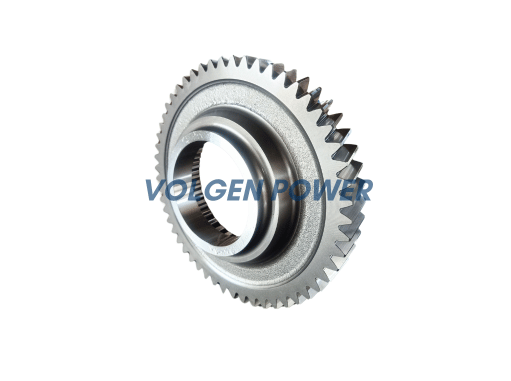
| Reference | Type | Application note |
|---|---|---|
| 1297 304 484 / 1297304484 | ZF synchro ring | 16S151 / 16S1650 / 16S221 family |
| 1297304402 | ZF reference in the same group | Confirm against the BOM; do not substitute by appearance |
| 1297 304 515 | ZF synchro ring | 16S2530 |
| 95531072 | Euroricambi | Aftermarket equivalent for 1297304484 group |
| 119167 | CEI | Aftermarket equivalent |
| 3.51005 | DT Spare Parts | Aftermarket equivalent |
| 81.32420.0146 | MAN reference | Used on MAN applications of the same ZF unit |
Aftermarket rings can be dimensionally correct and still differ in friction material. Ask what the inner cone is coated with, and do not mix a molybdenum ring with a carbon ring on the same shaft unless the ZF parts list allows it. Mixed friction behaviour shows up as one gear that shifts differently from the rest.
Installation Checks That Prevent a Comeback
- Clean the cone and ring with a lint-free cloth; no solvent residue on the friction surface.
- Fit a new ring on a worn cone only if the cone is within spec — otherwise the new ring wears out quickly.
- Check the shift sleeve and fork for wear; a worn fork tilts the ring and damages the teeth.
- Set the linkage and check clutch release; drag loads the synchro on every shift.
- Use the specified oil and level; the wrong oil changes friction behaviour.
- Road-test every gear, including range and splitter changes, before delivery.
Oil, Clutch and Linkage: What Kills New Rings
A new synchro ring cannot compensate for a dragging clutch. If the clutch does not release fully, the input shaft keeps turning and the ring has to overcome the difference on every shift. The driver feels grinding, the workshop replaces the ring, and the new part fails the same way. Check release travel and the release bearing before opening the gearbox.
Oil matters as much as the friction material. The wrong viscosity or a severely degraded oil changes the film on the cone and the speed at which the ring grabs. Use the ZF-approved lubricant for the transmission type and the operating temperature, and check the level at the fill plug, not by guesswork. A gearbox that shifts badly only when cold is often an oil problem, not a worn ring.
Bench Checks Before Fitting
Before the ring goes on the shaft, check it against the old part: cone angle, tooth count, tooth form and overall height. A ring that fits but has a different cone angle will either grab too early or not at all. Check the gear cone for a wear step at the contact band; a step means the cone needs replacement, not just the ring.
Check the shift sleeve and fork for rounded teeth and wear pads. A worn fork tilts the ring under load, which damages the blocking teeth and produces the jump-out complaint that brought the truck in. Replace the fork if the pad is worn through; a new ring on a worn fork is a repeat repair.
Related ZF Gearbox Overhaul Components
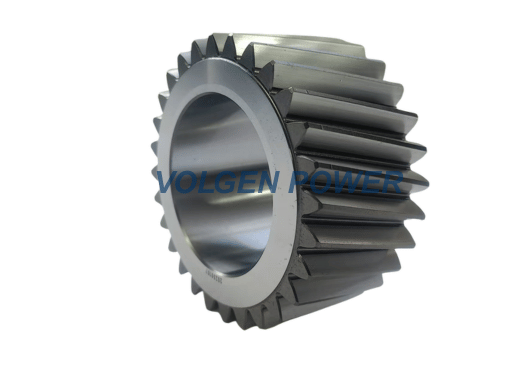
Replacing a synchro ring without checking the parts it works with is a partial repair. The shift sleeve and dog teeth take the same load cycle, and the gear cone is the friction partner. On a high-mileage Ecosplit it is normal to find a worn sleeve, a polished cone or a bearing that has started to rumble in the same gearbox.
Two examples from our ZF range show the kind of parts that are inspected at the same time: the ZF 1358304010 gear and the ZF 1358332262 planetary gear. They are not synchro rings and are not substitutes for one; they are the adjacent transmission components that decide whether the rebuilt gearbox shifts cleanly after the rings are renewed.
Check the sleeve for rounded teeth, the fork for worn pads, and the bearings for play before closing the box. A ring replacement that ignores those parts produces a gearbox that still grinds, and the new rings get the blame.
Sourcing and Quality Inspection from Volgen Power
Volgen Power supplies ZF Ecosplit transmission parts through the Shiyan commercial vehicle supply chain. For synchro rings the inspection points are the ones that decide shift quality: friction material, cone angle, tooth form and batch consistency.
- Number check. The ring is matched to the ZF reference and the BOM before packing.
- Friction surface. Coating type and coverage checked; a partially coated ring is rejected.
- Dimensional check. Cone angle and tooth form checked against the sample.
- Batch consistency. Rings from one batch are kept together so a rebuild does not mix friction behaviour.
- VCI packing. Rings are oil-protected for sea freight; a rusted cone is a rejected shipment.
Related reading: ZF transmission parts · Cummins engine parts
Ring or Gear Cone: Which One Is Worn?
The ring is the cheaper part, so it is tempting to replace it and hope. If the gear cone is polished, stepped or blue from heat, a new ring will not restore the friction coefficient. Compare the cone surface with a known-good gear: a distinct wear band, a step at the edge of the band, or a mirror polish means the cone is done. In that case replace the gear, not only the ring.
Record the wear-gap readings before and after the repair. A ring that measures at the limit when new, or a gap that closes faster than expected on the first service interval, points to a cone or oil problem rather than a bad ring. Keeping the numbers turns a repeat complaint into a diagnosable trend.
Check the cone angle with a gauge if the workshop has one. A cone that has worn concave will hold a new ring only briefly. On high-mileage Ecosplit units, rings and cones are usually replaced as a pair for the gears that do the most work — typically first, second and reverse.
Frequently Asked Questions
How do I know if my synchro ring is worn?
Measure the gap between the ring and the gear cone with a feeler gauge, then compare it with the ZF wear limit for your BOM. Grinding or a blocked shift with a closed gap confirms wear.
Can I fit 1297 304 515 to a 16S151?
No. 1297 304 515 is the 16S2530 reference. The 16S151/16S1650/16S221 family uses 1297 304 484. Confirm the BOM before ordering.
What is a Stücklisten-Nr?
It is the 10-digit ZF assembly number on the transmission plate. It identifies the exact build, which is what decides the correct synchro ring when the type badge alone is ambiguous.
Are molybdenum and carbon rings interchangeable?
Only where the ZF parts list allows it. They behave differently in service; mixing them on one shaft can make one gear shift differently from the rest.
Why does my gearbox still grind after new rings?
Check the gear cones, sleeve and fork for wear, and confirm clutch release and linkage adjustment. A new ring on a worn cone or with a dragging clutch will grind again.
Need a Synchro Ring Matched to Your ZF BOM?
Send the transmission plate photo, the 10-digit Stücklisten-Nr and the old ring number. We will confirm whether you need 1297 304 484 or 1297 304 515, and quote with the friction type stated.
WhatsApp our parts desk: +86 188 7263 0128 — include BOM, type and quantity.