Quick Answer: The OM501 (11.9 L V6) and OM502 (15.9 L V8) share a modular design — one cylinder head per cylinder, common piston and liner service parts — but the major castings are not interchangeable. The OM501 block is a six-cylinder casting; the OM502 is an eight-cylinder casting. The OM501 crankshaft runs in four main bearings, the OM502 in five, with different counterweights, crankpin angles and camshaft length. Identify the engine from the plate (541.9xx for OM501, 542.9xx for OM502) before ordering a block or crank.
Table of Contents
- Why the Two Engines Look Related but Do Not Share Major Parts
- OM501 vs OM502: What Is Shared and What Is Not
- The Crankshaft Is Where Most Wrong Orders Happen
- Reading the Engine Plate Before You Order
- Cylinder Block: What the Casting Number Tells You
- Shared Service Parts: Useful, but Verify by Number
- Sourcing and Quality Inspection from Volgen Power
- Frequently Asked Questions
- Need an OM501 or OM502 Block or Crankshaft?
Why the Two Engines Look Related but Do Not Share Major Parts
Mercedes-Benz built the OM501 and OM502 as a modular heavy-duty family for Actros and other commercial vehicles. Modularity works at the cylinder level: each cylinder has its own head, its own piston and liner assembly, and its own injector. That is why a workshop can service one cylinder without touching the rest of the engine, and why some service parts are common across the family.
Modularity stops at the block and the crankshaft. A V6 block cannot become a V8 block, and a V8 crankshaft cannot be made to fit a V6 crankcase. The two engines differ in cylinder count, firing sequence, main-bearing count, counterweight layout and camshaft length. Buyers who order by engine family name instead of engine number are the ones who end up with a crank that will not turn in the block.
OM501 vs OM502: What Is Shared and What Is Not
| Item | OM501 | OM502 | Interchangeable? |
|---|---|---|---|
| Layout | V6, 11.9 L | V8, 15.9 L | No |
| Cylinder block | Six-cylinder casting (5410102005 family) | Eight-cylinder casting | No |
| Crankshaft main bearings | 4 | 5 | No |
| Crankshaft | 541030xxxx family | 5420300101 family | No |
| Cylinder heads | One per cylinder (6) | One per cylinder (8) | Head design is shared per cylinder, head count is not |
| Camshaft | V6 length | Longer V8 shaft | No |
| Piston and liner service set | Per-cylinder module | Per-cylinder module | Confirm by part number and engine plate |
| Engine plate prefix | 541.9xx | 542.9xx | No |
The Crankshaft Is Where Most Wrong Orders Happen
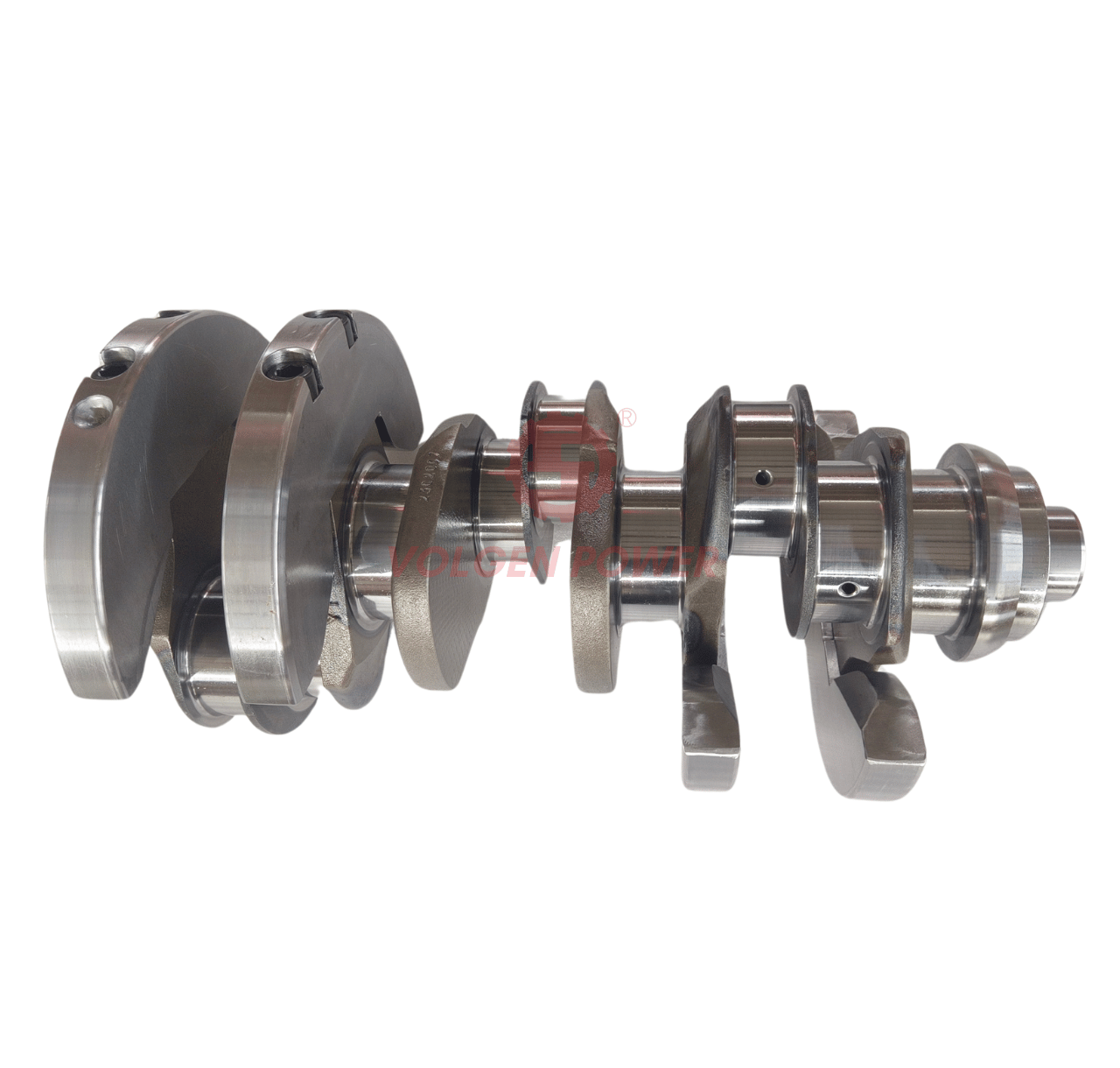
The OM501 crank runs in four main bearings; the OM502 crank runs in five. That difference alone decides whether the shaft will sit in the block. Beyond the bearing count, the two shafts differ in counterweight mass, crankpin angle and overall length, because the firing intervals of a 90° V6 and a 90° V8 are not the same. A shaft that physically drops into the crankcase but has the wrong throw layout will not time correctly and cannot be balanced to run smoothly.
Within the OM501 family there are also several crank references for different production periods and applications. Our catalogue carries the 5410300801 / 5410301801 / 5410301901 OM501 crankshaft, plus the 5410302001 / 5410302801 and 5410300601 / 5410300201 references. They are not automatically interchangeable with each other — the engine number and the old crank number decide.
For the V8, the reference we carry is the 5420300101 OM502 crankshaft. It is a five-main forged shaft and is not a substitute for any 541030xxxx part.
Reading the Engine Plate Before You Order
The plate is the fastest way to separate the two engines. OM501 units carry a 541.9xx engine designation; OM502 units carry 542.9xx. Photograph the plate, the engine serial and the old part number, and send all three. A supplier who quotes from the engine family name alone is guessing.
Two more checks are worth doing before payment. First, confirm the block casting number and the number of main-bearing webs visible in the crankcase. Second, confirm the camshaft length if the order includes a cam — a V8 shaft will not fit a V6 head sequence. Our Mercedes-Benz crankshaft range lists the references by engine family, and the Mercedes-Benz engine parts category covers the matching blocks and service parts.
Cylinder Block: What the Casting Number Tells You
The OM501 block we list is the 5410102005 six-cylinder block. It carries six cylinder bores and four main-bearing saddles. The OM502 block carries eight bores and five saddles. There is no machining operation that turns one into the other, and no adapter kit that makes a V8 crank fit a V6 block.

Shared Service Parts: Useful, but Verify by Number
The per-cylinder module is where the family shares parts: a single head, a piston and liner assembly, an injector and the associated seals. That is a real advantage for a fleet running both V6 and V8 Actros units, because the same workshop skills and some of the same service parts apply. It is not a licence to order by description. The head and liner part numbers still change with production period and application, and the piston must match the liner and ring pack.
| Order | Correct approach | Typical mistake |
|---|---|---|
| Cylinder head | One per cylinder, matched to the engine number | Buying a "V8 head set" and assuming V6 uses the same casting batch |
| Piston and liner | Order as a matched set with rings | Mixing a liner from one production period with a piston from another |
| Crankshaft | Confirm main-bearing count and reference | Ordering a 541030xxxx shaft for a 542.9xx engine |
| Camshaft | Match length and engine variant | Assuming a V6 cam fits a V8 head sequence |
Main Bore Alignment and Main Bearing Selection
Fitting a crankshaft into a block without checking main bore alignment is a gamble. The OM501 and OM502 blocks are long castings that carry four and five main saddles respectively, and a block that has spun a bearing or been overheated can have a saddle out of line even when the deck looks flat. Measure bore alignment with a mandrel or a dial gauge on the saddles; if it is out, line boring is the only correct repair.
Bearing selection follows the measurement, not the other way round. Main shells are graded by thickness, and the grade must match the journal it serves. Mixing grades on one engine changes oil clearance at one saddle, which changes the load path and often produces a repeat failure within a short mileage. On a reground crank, the shells must match the grind step as well as the bore grade.
- Measure bore alignment before the crank goes in; record each saddle.
- Measure each journal in two planes and match the shell grade to the measured clearance.
- Check thrust clearance after torquing the main caps, then rotate the assembly by hand.
- Verify oil clearance on every journal, not only the first one.
- Do not mix new and used shells on one engine.
If the block needs line boring, the crank may also need a grind to the next undersize to keep clearance in range. Treat the two operations as one repair: boring the block and leaving the crank at its worn size usually puts clearance outside the specification.
Installation Checks After a Block or Crank Change
A replacement crank is only half the job. Before the sump goes back on, measure main bore alignment and roundness, check thrust bearing end float, and confirm that every main shell is the correct grade for that journal. A crank that measures perfectly on the bench will still fail if the block has a spun bearing or a distorted main saddle.
On the OM501 and OM502 the firing sequence loads the crank differently from an inline engine, so the balancer and flywheel must go back in the same orientation they came off. Mark the flywheel before removal. Refit the balancer with the specified bolt and washer; a re-used balancer bolt can lose clamp load and let the damper walk.
- Measure main bore alignment before fitting the crank; line boring is not optional if the bore is out.
- Check thrust clearance after torquing the main caps, not before.
- Verify each main shell grade against the journal it serves; do not mix grades on one engine.
- Check crank end float and rotate the assembly by hand before fitting the rods.
- Prime the oil system before the first start and change oil early after break-in.
Comparing a Used Crank With the Replacement
When a core is returned or a used crank is offered, compare it with the replacement on four points: overall length, number of main journals, counterweight profile and crankpin throw positions. A V8 shaft beside a V6 shaft is obvious once both are on the floor; the expensive mistake is ordering by photograph without checking the number.
Measure the journals in two planes at both ends and record taper and out-of-round. A shaft ground below the last undersize, or one with a damaged fillet radius, is scrap no matter how good the journals look. Crack testing at fillets and oil holes is mandatory before a used shaft is accepted.
Freight, Packing and Documentation
A block or crankshaft is a heavy, dimension-critical shipment. Cranks travel on a wooden cradle with journals protected and the shaft restrained so it cannot move against the crate. Blocks are bolted to a pallet, deck face protected and coolant passages drained. Ask for photographs of the packed item before dispatch and check the crate for impact damage on arrival.
Shipping documents should carry the part number, engine family (OM501 or OM502) and the engine serial the part was matched to. That record makes a warranty claim traceable to a casting or forging batch instead of a conversation.
Sourcing and Quality Inspection from Volgen Power
Volgen Power supplies OM501 and OM502 blocks, crankshafts and per-cylinder service parts through the Shiyan commercial vehicle supply chain in Hubei. For a heavy crankshaft the inspection points are the ones that decide whether the engine runs smoothly: material grade, main-journal geometry, fillet radius, crack test and balance.
- Reference check. The part number is matched to the engine plate and the old component before packing.
- Crack test. Magnetic particle inspection on fillets and oil holes; a cracked shaft is scrapped, not reworked.
- Dimensional check. Journal diameter, taper and out-of-round measured; fillet radius checked against the grinder profile.
- Balance. Shafts are balanced and the report travels with the part on request.
- VCI packing. Journals are oil-coated and wrapped for sea freight; a rusted journal is a rejected shipment.
Frequently Asked Questions
Can I use an OM502 crankshaft in an OM501 block?
No. The OM501 crank runs in four main bearings and the OM502 crank in five, with different length, counterweights and crankpin angles. The shaft will not fit the crankcase or time correctly.
Are OM501 and OM502 cylinder heads the same?
Both engines use one head per cylinder, and the head design is shared at the cylinder level, but the part number still changes with production period and application. Confirm the head number against the engine plate and the old casting.
How do I tell an OM501 from an OM502?
The engine plate is the fastest check: OM501 units carry a 541.9xx designation and OM502 units 542.9xx. Cylinder count and main-bearing count confirm it physically.
Can I swap crankshafts between OM501 variants?
Only when the reference and engine number match. The OM501 family carries several crank numbers for different production periods and applications; they are not automatically interchangeable.
What should I send with a block or crank enquiry?
Send the engine plate photo, engine serial, the old part or casting number, and the number of main bearings if visible. That is enough to lock the correct reference before quoting.
Need an OM501 or OM502 Block or Crankshaft?
Send the engine plate photo, serial and the old part number. We will confirm the block or crank reference, tell you whether the part is in the V6 or V8 family, and quote with the inspection record attached.
WhatsApp our parts desk: +86 188 7263 0128 — include engine plate, serial and quantity.