Quick Answer: A Volvo D13 crankshaft is condemned by measurement, not by appearance. Measure every main and rod journal with a micrometer in two planes at both ends, then compare taper, out-of-round and diameter with the OEM specification for your engine variant. If the journals are within limits, fit standard bearings; if material has to be removed, grind to the next undersize and fit 0.25 mm, 0.50 mm or 0.75 mm undersize shells, never a mix of sizes on one journal. Replace the crankshaft when a journal is cracked, when the fillet radius is damaged, when hardness has been lost, or when the required grind would take the journal below the last undersize.
Table of Contents
- Why D13 Crankshaft Journals Wear
- Reading the Wear Pattern
- Step-by-Step Journal Inspection
- Standard and Undersize Bearings: How the Selection Works
- OEM Cross-Reference and Identification
- Installation and Break-In
- Sourcing and Quality Inspection from Volgen Power
- Frequently Asked Questions
- Need a D13 Crankshaft Checked Against Your Engine Serial?
Why D13 Crankshaft Journals Wear
The D13 is a 12.8 L inline-six built for steady high load. Its crankshaft is a forged steel part running in replaceable main and connecting-rod bearing shells. In a healthy engine the oil film keeps the journal and the shell apart. Every wear pattern on a D13 crank therefore points back to one of three things: the film broke down, the film was never the right thickness, or the geometry that supports the film changed.
In practice, workshops see the same six mechanisms again and again:
- Oil starvation at startup or under load. A worn oil pump, a restricted pickup, a collapsed filter or a low oil level removes the film at the moment load is highest.
- Contaminated oil. Soot and metal particles from a failing component act as lapping paste. The journal polishes, clearance opens, and the next stage is a knock.
- Wrong bearing clearance after a previous repair. A crank ground to an undersize but fitted with standard shells, or a shell installed with the wrong grade, runs with too little clearance and overheats.
- Torsional vibration and damper failure. A tired front damper lets the crank twist further than designed and fatigues the fillets.
- Over-speed or lugging. Both load the rod journals in ways the oil film was not sized for.
- Bent or misaligned block. Main bore misalignment loads the crank unevenly and produces a wear pattern that follows one line along the shaft.
Reading the Wear Pattern
Before you measure anything, look at where the wear sits. The position of the polished band tells you what happened, and it tells you whether a grind will fix it or merely hide it.
| Wear pattern | Usual cause | What it means for the crank |
|---|---|---|
| Even polishing around the whole journal | Normal service wear, fine contamination | Usually grindable to the next undersize if measurements allow |
| Heavy wear at one side of the journal, top or bottom only | Oil starvation, wrong clearance, bent rod or misaligned main bore | Find the cause before reusing the crank; a re-grind alone will wear the same way |
| Scoring or deep grooves | Hard particle embedded in the shell, or a spun bearing | Journals may need welding or replacement; check for heat damage |
| Blue or discoloured journal | Bearing seizure, loss of clearance | Hardness is suspect; a hardness check decides scrap vs grind |
| Step or ridge at the journal edge | Shell walked, or a previous grind left a sharp edge | Fillet radius may be compromised; radius must be restored on the grinder |
| Crack from an oil hole or fillet | Fatigue, torsional vibration | Crankshaft is scrap; do not grind a cracked crank |
Step-by-Step Journal Inspection
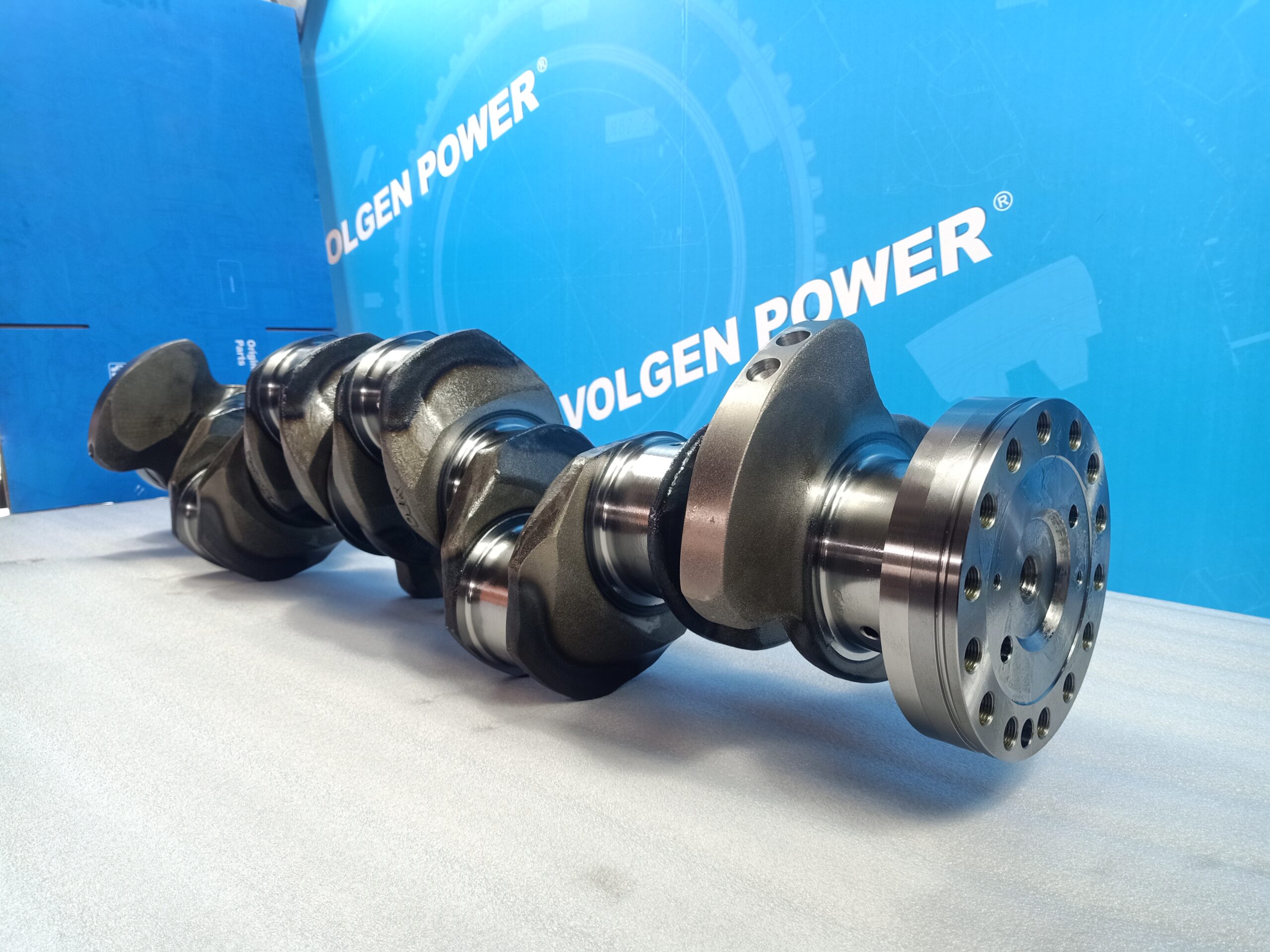
Step 1 — Clean and identify. If the engine plate is unclear, read the Volvo D13 block stamping and engine serial number, then confirm the variant against the Volvo D13 engine parts reference. Remove all oil, varnish and bearing material from the journals. Record the engine variant and serial number; the D13 family spans several emissions and output variants, and the journal specification is tied to the variant, not to the badge on the truck.
Step 2 — Measure with a micrometer, not a caliper. Use a calibrated outside micrometer reading to 0.001 mm. Take two readings 90° apart at each end of every journal — four readings per journal. Write them down; memory is not a measurement record.
Step 3 — Calculate taper and out-of-round. Taper is the difference between the two ends; out-of-round is the difference between the two planes at the same position. Compare both with the OEM limit for that journal. A journal that is round and parallel but uniformly small is a grind candidate; a journal that is oval or tapered is a grind candidate only if the correction stays above the minimum diameter.
Step 4 — Check the fillet radius and oil holes. The fillet is what keeps the crank alive in fatigue. A grinder that cuts a sharp corner removes the radius and creates a stress riser. Inspect the oil hole edges for chamfer and cracks; a crack that starts at the hole is not repairable.
Step 5 — Crack-test the shaft. Magnetic particle inspection is the standard workshop method for a steel crank. Clean the part, magnetise it, and inspect the fillets, oil holes and journal surfaces under proper lighting. Any indication at a fillet or oil hole condemns the shaft.
Step 6 — Check straightness and runout. Support the crank in V-blocks or in a lathe and measure runout at the centre main and at the flywheel flange. A bend that exceeds the OEM limit cannot be corrected by grinding; grinding a bent crank produces an eccentric journal that wears out the bearing.
Step 7 — Verify hardness after any heat event. A journal that has been hot enough to discolour has lost hardness. Check it with a portable hardness tester, or have the grinder check it before removing material. A soft journal will wear again quickly.
Step 8 — Measure the block before you fit anything. Use the Volvo Trucks service information for the variant when confirming clearances and torque values. Main bore alignment and roundness decide whether a new or re-ground crank will survive. If the block has spun a bearing, the bore is usually damaged and needs line boring or replacement before the crank goes back in.
Standard and Undersize Bearings: How the Selection Works
Crankshaft bearings are sold in a standard size and in stepped undersizes. The undersize refers to the amount removed from the journal diameter, not to the shell thickness alone: a 0.25 mm undersize shell is thicker so that it takes up the 0.25 mm that was ground off the crank. Volvo service practice uses 0.25 mm, 0.50 mm and 0.75 mm steps, and the crank must be ground to the matching dimension for the step you intend to use.
| Bearing size | When it is used | What must be true before fitting |
|---|---|---|
| Standard | Journal diameter and geometry are within OEM limits | Measurements recorded at four points per journal; no grinding required |
| 0.25 mm undersize | Crank has been ground 0.25 mm under nominal | Journal ground to the exact matching dimension, fillet radius restored, crank re-balanced |
| 0.50 mm undersize | Second grind step after significant wear or a previous 0.25 repair | Minimum diameter for the variant is not exceeded; hardness still acceptable |
| 0.75 mm undersize | Last practical step before replacement | Confirm the OEM minimum diameter; many D13 cranks are scrap beyond this point |
Two rules decide whether the job lasts. First, never mix sizes on one journal or one engine unless the OEM procedure explicitly allows it; a mismatched pair changes the oil clearance and load path. Second, verify clearance after assembly with plastigauge or a bore gauge, using the OEM clearance range — not a generic number copied from another engine. If the clearance is outside the range, the crank or the shells are wrong, and the engine will fail again.
When the crank is ground, the shop must also re-check balance. Removing material changes the mass distribution, and a D13 crank at fleet load will show that imbalance as vibration and main bearing wear. Ask for the balance report with the crank, not just a verbal assurance.
OEM Cross-Reference and Identification
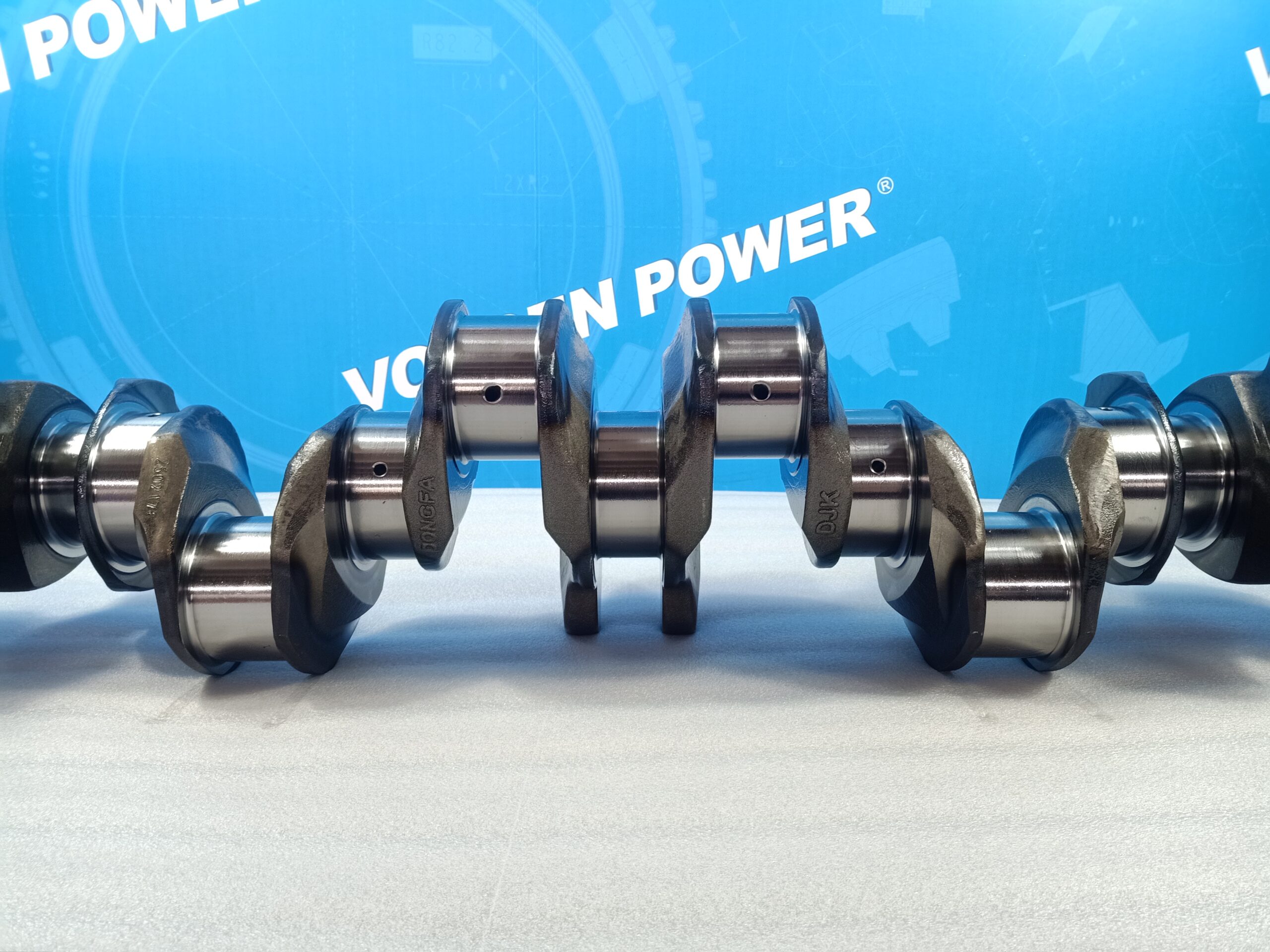
D13 crankshafts are listed under several OE numbers because the same basic forging was used across emission variants and because service replacements were superseded over time. The numbers below were cross-checked against current public parts catalogues. Treat them as identification leads and confirm the final number against the engine serial and the plate on the block.
| Number | Status in public listings | What to confirm |
|---|---|---|
| 21230583 | Listed as a D13 crankshaft and carried by Volgen Power as a D13 crankshaft | Engine variant, journal size, damper configuration |
| 22235114 | Listed in D13 crankshaft OE reference sets | Supersession path and whether it is a bare crank or a balanced assembly |
| 22697519 | Listed in D13 crankshaft OE reference sets | Variant match; some numbers cover industrial or marine versions |
| 23960143 | Listed in D13 crankshaft OE reference sets | Later production coverage; confirm with the engine serial |
| 20486221 / 20486222 | Listed as D13 crankshaft references, including 7420486222 | Whether the number is the crank only or includes the gear and damper |
| 85000536 | Appears in the same D13 crankshaft reference sets | Regional variant; do not assume interchangeability without the serial |
Handling a crankshaft safely is the first step of any inspection. This short demonstration covers rotating a D13 / MP8 crank on the stand without damaging the journals.
Installation and Break-In
- Clean the block main bores and the crank oil passages; a single particle left in a passage can destroy a new bearing.
- Check main bore alignment and roundness before fitting the crank.
- Lubricate shells with the specified assembly lubricant, not grease.
- Measure clearance on every journal, not only the first one.
- Check end float after the mains are torqued.
- Prime the oil system before the first start, then run at low load for the first hours and change the oil early.
- Check the crankshaft packing and receiving checklist before the crank goes on the bench.
Sourcing and Quality Inspection from Volgen Power
Volgen Power supplies forged steel crankshafts for the D13 and neighbouring Volvo engine families from a supply chain built around the Shiyan commercial vehicle cluster in Hubei. For a heavy crankshaft the inspection list matters more than the brochure: the part has to be straight, hard, crack-free and dimensionally correct before it can be balanced.
- Material verification. The forging batch is checked against the ordered grade, and the heat number is recorded against the shipment.
- Dimensional check. Main and rod journals are measured for diameter, taper and out-of-round, and the fillet radius is checked on the grinder profile.
- Crack test. Magnetic particle inspection on fillets and oil holes before packing; a cracked crank is never reworked and re-sold.
- Balance. Cranks are balanced and the report travels with the part on request.
- VCI packing. Journals are oil-coated and wrapped in VCI film for sea freight; a rusty journal is a rejected shipment on arrival.
- Traceability. The batch record links the crank to its forging lot, so a claim can be traced instead of argued.
Related reading: 21230583 OEM crankshaft for Volvo D13 · Volvo D13 engine parts · Crankshaft packing and receiving checklist for importers
Frequently Asked Questions
How do I know if my D13 crankshaft needs grinding or replacement?
Measure every journal in two planes at both ends. If taper and out-of-round are within the OEM limits and the diameter can be corrected above the minimum for the variant, the crank can be ground to the next undersize. Cracks, a damaged fillet, lost hardness or a bend beyond the limit mean replacement.
Can I fit 0.50 mm bearings after a 0.25 mm grind?
Only if the crank is ground again to the 0.50 mm dimension. Bearing undersize must match the amount removed from the journal. Fitting a thicker shell on a journal ground to a different step gives the wrong oil clearance and will fail.
What is the minimum diameter for a D13 crankshaft journal?
It depends on the engine variant. Volvo publishes the nominal and minimum diameters per variant in the service information, and 0.25 / 0.50 / 0.75 mm undersizes are the normal service steps. Do not use a figure from another D13 variant or from a forum post.
Why did my new bearings fail after a crank grind?
The usual causes are the wrong undersize, clearance outside the OEM range, a sharp fillet left by the grinder, a bent crank, contamination in the oil passages, or a main bore that was not checked. Measure clearance on every journal and check bore alignment before blaming the shells.
Is a re-ground crank as strong as a new one?
A correctly ground crank that stays above the minimum diameter, keeps its fillet radius and passes crack testing is a normal service repair. A crank ground below the limit, with a sharp fillet or with heat damage is not equivalent to new and should not be fitted.
Need a D13 Crankshaft Checked Against Your Engine Serial?
Send the engine serial, the variant code and photos of the old crank's journals. We will confirm the correct OE reference, tell you whether a grind is still possible, and quote a forged replacement with the inspection record attached. No number is guessed and no supersession is assumed without telling you the chain.
WhatsApp our parts desk: +86 188 7263 0128 — include engine serial, variant and quantity. Or see the 21230583 D13 crankshaft listing for current options.