Quick Answer: An ISX15 cylinder head almost never cracks because of one bad heat cycle. It cracks because a local hot spot — usually the bridge between two valve seats or the injector cup bore — has been fed by a coolant leak, a leaking injector cup seal, or a deck that is no longer flat. The crack is the last symptom, not the first cause. To decide between repairing and replacing, pressure-test the bare casting, check deck flatness and valve recession against the OEM specification for your CPL, and replace the head if a crack reaches a seat ring, a journal bore, or a water passage. Volgen Power supplies bare and complete ISX15/QSX15 heads built to OEM interchange numbers, with the identification checks described below.
Table of Contents
- Why Cummins ISX15 Cylinder Heads Crack
- ISX15 Cylinder Head Failure Mechanisms at a Glance
- Where Cracks Start on an ISX15 Head
- Step-by-Step Inspection Guide
- Inspection Methods and What They Actually Prove
- Bare Head or Complete Head? A Buying Decision, Not a Price Decision
- OEM Cross-Reference and Identification
- Installation Errors That Kill a New Head
- Sourcing and Quality Inspection from Volgen Power
- Frequently Asked Questions
- Need a Verified ISX15 Head for Your CPL?
Why Cummins ISX15 Cylinder Heads Crack
The ISX15 is a 14.9 L inline-six with a 24-valve cast iron cylinder head. The casting carries the valve seats, the injector cups, the camshaft bores on some configurations, and the coolant passages that cool all of them. That combination means the head lives with two different loads at once: high-frequency mechanical load from valve closing and cylinder pressure, and slow thermal load from every warm-up and cool-down.
Cast iron tolerates compression well. What it does not tolerate well is a temperature difference across a small section of the casting. The bridge between the intake and exhaust valve seats is only a few millimetres wide, and it is heated from both sides. When the exhaust seat runs hotter than the intake seat, that bridge is restrained by the cooler metal around it and develops a tensile stress cycle every time the engine heats and cools. Once a crack starts there, coolant or combustion gas finds it quickly.
That is why the useful diagnostic question is not "why did it crack?" but "what made that spot hotter or weaker than the rest of the head?" In practice, four answers cover most ISX15 head failures:
- Injector cup seal leakage. Coolant reaches the injector bore, steam-erosive damage follows, and the crack opens from the cup bore outward.
- Coolant-side neglect. Low coolant level, air pockets, a stuck thermostat, a clogged EGR cooler, or the wrong coolant chemistry all raise metal temperature locally before the gauge shows a problem.
- Over-fueling or timing faults. A dripping injector or a retarded timing event raises exhaust gas temperature and pushes the exhaust seat area past its design margin.
- Installation and deck damage. A warped deck, re-used head bolts, dirty bolt holes, or incorrect torque sequence bend the head on the block and pre-load the casting.
ISX15 Cylinder Head Failure Mechanisms at a Glance
| Mechanism | Where it shows up | First symptom the driver or shop notices | How to confirm it |
|---|---|---|---|
| Thermal fatigue of the valve bridge | Between intake and exhaust seat rings, usually cylinders 5–6 on a working truck | Slow coolant loss with no external leak, white exhaust haze | Dye penetrant or magnetic particle inspection after cleaning; pressure test |
| Injector cup seal failure | Injector bore wall and cup counterbore | Coolant in the fuel rail area, rough running, coolant loss | Cup removal, bore inspection, pressure test with cups installed |
| Coolant-side erosion or cavitation | Water jacket around exhaust ports | Overheating under load, heater performance drop | Coolant flow test, borescope through the water passage, pressure test |
| Exhaust seat recession and hammering | Exhaust seat ring and seat pocket | Valve lash closing up, misfire, loss of compression | Valve recession measurement against the OEM limit for the CPL |
| Deck distortion from a previous repair | Fire deck, around head bolt holes | Repeat head gasket failure, coolant pressurisation | Straight-edge and feeler gauge check, then surface profile check |
| Crack from over-torque or re-used bolts | Bolt bosses and camshaft bore saddles | Oil pressure drop, cam bore scoring, noise | Bore measurement, visual inspection, line-bore check |
None of the entries above is a specification. The acceptance limits for each one — recession, flatness, guide clearance, crack length, seat concentricity — come from the Cummins service information for the specific CPL and engine serial number. Use those numbers, not numbers copied from another engine family.
Where Cracks Start on an ISX15 Head

The valve bridge
The bridge between the intake and exhaust seat is the classic ISX15 crack location. A crack here usually begins at the exhaust seat ring, not in the middle of the bridge, and travels toward the injector bore or the water jacket. Any crack that reaches the seat ring means the seat will not hold its interference fit, so the head is no longer a candidate for resurfacing and re-seating.
The injector cup bore
Cup seal failures are often blamed on the cup itself. The more common chain is a damaged or hardened O-ring, a bore that was not cleaned before the cup was pressed in, or a cup installed at the wrong depth. Once coolant passes the seal, the bore wall erodes and the head starts losing coolant without any visible leak. By the time the crack is visible, the bore is usually out of specification.
Exhaust port and water jacket
Cracks that start on the coolant side are harder to see and easier to misdiagnose. They grow from the water jacket toward the exhaust port wall, and they show up first as unexplained coolant consumption or pressure in the cooling system. A head that passes a cold pressure test can still fail when it is hot, which is why the pressure test should be repeated at operating temperature where the shop has the equipment to do it safely.
Step-by-Step Inspection Guide
Step 1 — Clean the casting properly. Cracks hide under carbon and scale. Hot-tank or ultrasonic clean the head, then glass-bead the combustion face and the exhaust ports. Do not shot-peen or grind the deck before inspection; you will remove the evidence and may remove the material you need to measure.
Step 2 — Inspect visually under magnification. Look at the valve bridges, injector bores, seat pockets, bolt bosses and cam bores. Record any rust trails or coolant staining, because a stain is a map to the leak path even when no crack is visible yet.
Step 3 — Dye penetrant or magnetic particle test. Dye penetrant is the practical choice for a cast iron head in a repair shop; magnetic particle inspection is better where the crack is on or near the surface and the shop has a yoke. Both methods only find cracks that reach the surface. Neither replaces a pressure test.
Step 4 — Pressure-test the water jacket. Blank the coolant ports, fill the jacket, and pressurise to the value in the OEM procedure. Watch for a pressure drop and look for seepage at the seats, cups and deck. A head that will not hold pressure is scrap, regardless of how good the combustion face looks.
Step 5 — Check deck flatness. Use a straight edge and feeler gauge across the full length and width, then diagonally. If the deck is outside the OEM flatness limit, the head must be resurfaced or replaced — and if it has already been resurfaced, check the remaining deck thickness before removing more material.
Step 6 — Measure valve recession and guide clearance. Recession is measured from the deck face to the valve tip or the seat contact, depending on the OEM method. A seat that has sunk closes up the lash, holds the valve off its seat, and burns the valve. Guides are measured with a dial bore gauge or a valve stem with a dial indicator; worn guides tilt the valve and crack seats.
Step 7 — Inspect the injector cups and cam bores. Remove the cups, inspect the counterbores for erosion and out-of-round, and check cam bore alignment if the engine had low oil pressure or a cam failure. A cracked cam saddle is a fatal defect for the casting.
Inspection Methods and What They Actually Prove
| Check | What it proves | What it does not prove |
|---|---|---|
| Visual + magnification | Surface damage, staining, obvious cracks | Hidden cracks, porosity, internal leakage |
| Dye penetrant / MPI | Surface-breaking cracks | Cracks that stop below the surface; water jacket integrity |
| Cold pressure test | Leaks in the jacket and cup bores at test temperature | Hot-running behaviour; a head can pass cold and leak hot |
| Deck flatness check | Whether the head can seal on the block | Whether the block deck itself is flat |
| Recession and guide measurement | Valve train geometry and remaining seat life | Casting cracks elsewhere in the head |
| Cam bore check | Whether the head can hold oil pressure and cam alignment | Valve spring and rocker condition |
Bare Head or Complete Head? A Buying Decision, Not a Price Decision
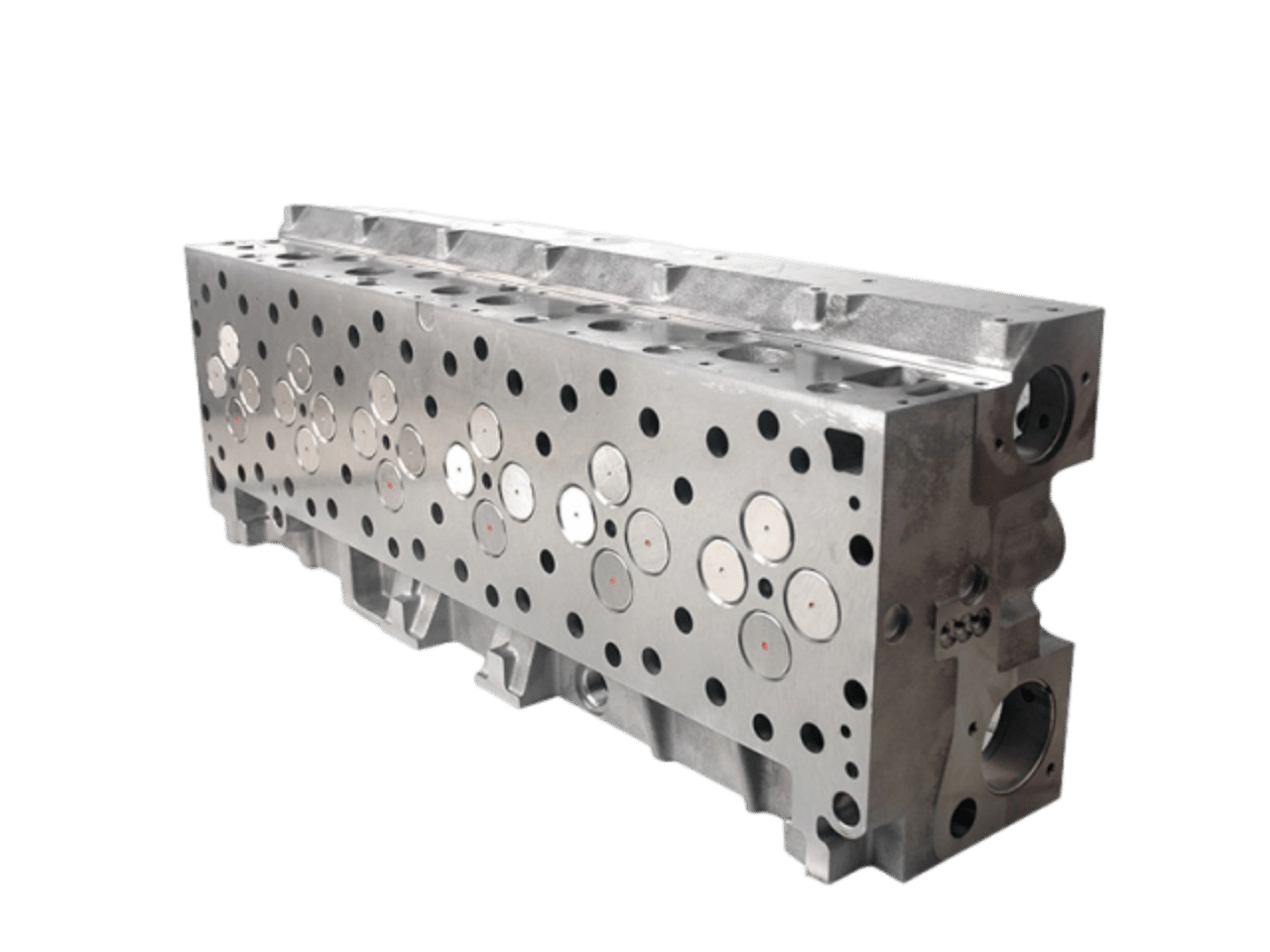
A bare head is the casting with seats, guides and cups installed but no valves, springs, retainers or injectors. A complete head arrives loaded. The right choice depends on what is reusable from the old head, not on the headline price.
| Your situation | Bare head | Complete head |
|---|---|---|
| Valves, springs and rockers are within spec and can be transferred | Best value; you control the valve job | Pays for parts you already have |
| Old head has cracked seats, burnt valves or worn guides | Requires a full valve job and seat work | Faster turnaround, single warranty path |
| Fleet shop with limited machining capability | Risky unless you have a seat machine | Recommended |
| Emergency roadside or workshop with a deadline | Slower, more labour | Recommended |
| You need to match a specific CPL exactly | Verify casting and seat configuration | Verify the loaded assembly number, not just the casting number |
OEM Cross-Reference and Identification
Cummins ISX15 and QSX15 heads circulate under several numbers because the same casting is sold as a bare head, a loaded head, and a service assembly. The numbers below are the ones that appear most often in public parts listings and in our own product data: 4963732 as the head casting, 4962732 as the mainstream complete head assembly for this engine family, and 4331187, 5413782 and 5658283 as further complete-assembly references seen in the market. They were cross-checked against current public parts catalogues. They are a starting point for identification, not a substitute for the CPL check.
| Number | What it is normally used for | Check before ordering |
|---|---|---|
| 4963732 | ISX15 / QSX15 cylinder head casting number used for bare and loaded heads | Casting number on the head, CPL, valve cover configuration |
| 4962732 | ISX15 / QSX15 complete cylinder head assembly — the mainstream assembly number for this engine family | Confirm whether the unit is bare or loaded, and match the CPL |
| 4331187 | ISX15 / QSX15 complete cylinder head assembly number, used alongside 4962732 | Loaded vs bare, injector style, camshaft bore configuration |
| 5658283 | Complete head assembly number seen alongside 4331187 in public listings | Confirm it is the assembly, not a component of it |
| 5413782 | Head-related number seen in ISX15/QSX15 listings | Ask the supplier which level of assembly it covers |
For a broader comparison of ISX head numbers, see our Cummins ISX series cylinder head buying guide.
Before ordering, confirm the engine identity with our Cummins ESN and CPL identification guide. Three checks settle the identification question faster than any catalogue: the casting number cast into the head, the engine CPL plate, and the injector and valve cover arrangement. Photograph all three and send them with the engine serial number. A supplier who cannot answer from those three should not be shipping you a head.
If you are comparing replacement options before ordering, this independent workshop comparison of ISX cylinder head quality is a useful second opinion on what separates a good casting from a cheap one.
Installation Errors That Kill a New Head
- Re-using torque-to-yield bolts. They have already stretched; re-using them changes clamp load and distorts the head.
- Dirty or oily bolt holes. Hydraulic pressure in a blind hole can crack the block or give a false torque reading.
- Skipping the torque sequence. The sequence exists to seat the head progressively, not to save five minutes.
- Not checking the block deck. A flat head on a warped block will leak again, and the new head gets the blame.
- Dry injector cup installation. Cups and bores need the specified lubricant and depth; a dry cup tears its seal.
- Wrong coolant or trapped air. Both create the local hot spot that started the original crack.
Sourcing and Quality Inspection from Volgen Power
Volgen Power works out of the Shiyan commercial vehicle cluster in Hubei, where Cummins-related castings, machining and heat treatment suppliers sit within a short drive of each other. That density is useful for a buyer: it makes small batch orders practical and it makes it possible to inspect a casting at the foundry before it is machined.
Our inspection routine for ISX15 heads covers the points that decide whether a head survives its first 100,000 km:
- Casting verification. The casting number and material grade are checked against the order, and the batch is recorded against the shipment.
- Machining checks. Deck flatness, seat concentricity, guide bore size and cup bore depth are measured, not eyeballed.
- Pressure test. Every head is tested on the water jacket before it is packed, and a failed head is scrapped rather than reworked and re-sold.
- VCI packing. Heads are oil-protected and packed with VCI film for sea freight, because a rusty deck is a rejected shipment.
- Traceability. The batch record travels with the invoice so a claim can be traced to a casting lot instead of a guess.
We supply bare and complete heads, and we will quote either against the numbers above or against photos of your casting and CPL. If your requirement is a fleet programme rather than a single unit, send the engine list and we will build the cross-reference before quoting.
Related reading: Cummins ISX15 / QSX15 cylinder head 4963732 / 4331187 · How to choose and buy Cummins ISX series cylinder heads · Diesel cylinder head problems: 7 common issues
Frequently Asked Questions
Can a cracked ISX15 cylinder head be repaired?
Only in narrow cases. A crack that stops in a low-stress area away from a seat ring, injector bore or cam bore can sometimes be pinned or stitched by a specialist. A crack that reaches a seat ring, a cup bore or a water passage is a replace, not a repair — welding cast iron in those areas rarely holds under thermal cycling.
What are the first signs of an ISX15 head crack?
Unexplained coolant loss with no external leak, white exhaust haze, pressure in the cooling system, and a coolant smell at the overflow tank. Rough running or a misfire appears later, once the crack reaches a combustion chamber or a valve seat.
Is 4963732 the same as 4331187?
No. 4963732 is used as the cylinder head casting number for ISX15/QSX15 heads; 4331187 is used for the complete head assembly. A bare head and a loaded head therefore do not carry the same commercial number. Confirm the assembly level and the CPL before ordering.
How do I know if my head is bare or complete?
A bare head has seats, guides and injector cups installed but no valves, springs, retainers or injectors. A complete head arrives assembled and ready to bolt on. Photograph the combustion face and the top deck; the presence of valves and springs settles it immediately.
What causes repeat head gasket failure after a new head?
Usually the block deck, not the head. A deck that is out of flatness, a damaged liner protrusion or dirty bolt holes will distort the new head and leak again. Check the block deck and liner stand-out before fitting a replacement head.
Need a Verified ISX15 Head for Your CPL?
Send the casting number, the CPL and a photo of the old head. We will confirm whether you need a bare or complete assembly, quote against the correct number, and tell you what the freight and packing will look like before you commit. No number is guessed and no "equivalent" is substituted without telling you the difference.
WhatsApp our parts desk: +86 188 7263 0128 — include CPL, casting number and quantity. Or browse the Cummins ISX15 / QSX15 cylinder head page for current options.