Heavy-duty trucks depend on reliable axle systems. Whether it is long-haul logistics, off-road mining fleets, or mixed-duty transport operations, axle performance influences fuel efficiency, load capacity, braking stability, differential behavior, and total cost of ownership. Meritor axles have become one of the world’s most widely used driveline solutions because they balance durability, serviceability, and component interchangeability.
Table of Contents
Understanding Meritor Axle Categories

Meritor offers a wide portfolio of axle families designed for varying load profiles, terrains, and drivetrain configurations. For procurement teams or fleet engineers, knowing the correct axle classification improves compatibility checks and service planning.
Single Axle (Non-Driving Axle)
Used in medium-duty trucks or as a secondary axle in tandem configurations.
Key characteristics:
- Lightweight design
- Lower torque requirements
- Supports load distribution
- Often paired with air suspension systems

Meritor Drive Axle
This is the core of Meritor’s drivetrain product line, used in heavy-duty long-haul, mining, refuse collection, and construction trucks.
Key functions include:
- Transmitting torque from the propeller shaft
- Supporting differential and carrier assemblies
- Managing axle ratios and torque distribution
Meritor Rear Axle Assemblies
Designed to manage load stress and multi-axle configurations.
Typical applications:
- Volvo, Freightliner, Kenworth, Iveco, Scania, and other heavy trucks
- On-highway logistics
- Multi-axle tippers
- Oilfield equipment
Tandem / Multi-Axle Systems
Used in extreme-duty fleets.
Benefits:
- Improved traction
- Higher permissible load
- Even torque distribution
Drive Modules & Drivetrain Systems
Integrated systems combining axles, carriers, differential kits, and brake assemblies.
For deeper component-level information, you can refer to your internal product categories, such as:
- Axle Shafts
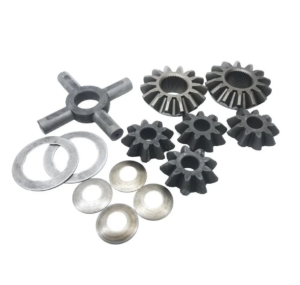
- Differential Repair Kits
- Wheel Seal Kits


Technical Specifications of Meritor Axles
This section summarizes the core technical determinants used by maintenance engineers, technicians, and procurement teams.
Axle Ratios: Selection Guide and Impact Analysis
Axle ratios influence torque, fuel economy, gradeability, and drivetrain temperature. The ratio is the division of the Ring Gear Teeth by the Pinion Gear Teeth ($R/P$).
Meritor Axle Ratio Selection Guidelines
| Ratio Range | Application Type | Primary Goal | Fuel Efficiency | Torque/Gradeability |
| 3.36–3.70 | Long-haul Highway | High cruising speed | Excellent | Medium |
| 3.70–4.10 | Mixed-duty Fleets | Universal performance | Good | Good |
| 4.10+ | Heavy Construction/Mining | Maximum torque | Medium | Excellent |

Load Capacity Ranges and Engineering Considerations
Meritor axles are engineered to meet specific GAWR (Gross Axle Weight Rating).1 Choosing a replacement part that matches or exceeds the original GAWR is non-negotiable for safety and compliance.
| Axle Type | Typical Load Range | Primary Applications |
| Single Axle | 9–13 tons | Medium-Duty Trucks, Trailers |
| Tandem Axle | 21–26 tons | Heavy-Duty Logistical Trucks |
| Specialized Units | Up to 32 tons | Mining Fleets, Oilfield Equipment |
Engineering Considerations: Bracket reinforcement, Hub design, Carrier casting strength, Heat treatment processes.
Assembly Architecture and Differential Locking Systems
Core elements: Differential carrier, Axle shafts, Wheel hubs, Bearings, Seal sets, and Brake assemblies.
Differential Lock (DCDL): Meritor's Driver-Controlled Differential Lock (DCDL) is a critical component for off-road and low-traction conditions. When engaged, the DCDL locks the two axle shafts together, providing equal torque to both wheels. Procurement of DCDL-compatible carrier components (e.g., side gears, clutch pack) must be precise to maintain this essential off-road function.
Meritor Axle Parts: Carrier, Axle Shafts, Differential Kits, & Seal Kits
Understanding the full parts ecosystem reduces incorrect purchases and service delays.
Carrier Assemblies (The Axle Heart)
Functions include torque transfer and differential operation.
Evaluation criteria: Gear mesh consistency, Heat treatment uniformity, Bearing preload tolerances.
Axle Shafts (The Torque Transmitters)
Often replaced after fractures, spline deformation, or bearing wear.
Quality indicators: Alloy steel grade, CNC machining precision, Spline hardness, Torsional load testing.
VOLGEN POWER Insight: Our Meritor-compatible axle shafts undergo strict induction heat treatment to maximize spline hardness, ensuring superior resistance to torsional stress.
Differential Repair Kits
Used during major axle overhauls.
Typical components: Ring gear, Pinion gear, Bearings, Crush sleeves, Shims, and Adjustment kits.
Seal Kits (Preventing Catastrophic Failure)
Seal failure is one of the most common sources of grease loss and oil contamination.
Includes: Hub oil seals, Pinion seals, O-rings, Gaskets.
VOLGEN POWER Insight: We source high-grade synthetic polymer seals designed for an extended temperature range and chemical resistance, reducing premature oil leakage.
Maintenance Cycles and Lubrication Guide
Fleet operators report that proactive axle maintenance increases service life by 30–40%.
Maintenance Intervals (Kilometer Guide)
| Interval (km) | Inspection Focus | Action |
| 20,000–30,000 km | Hub seals, Noise/Vibration | Verify oil level, visual inspection |
| 60,000–80,000 km | Gear wear, Carrier backlash | Verify axle alignment, bearing play |
| 120,000–150,000 km | Oil contamination, Spline condition | Replace differential oil, change bearings (if needed) |

Lubrication & Bearing Preload Standards
Lubrication quality directly affects gear mesh temperature, seal life, and overall axle durability.
Recommended Gear Oils: 75W-90 synthetic (standard), 80W-140 synthetic (extreme duty).
Bearing Preload Essentials (Crucial for Durability)
Bearing preload refers to the controlled axial force applied to tapered roller bearings within the carrier or wheel hub.2 Correct preload ensures optimal rolling resistance and dramatically extends service life.
- Too much preload: Causes overheating, excessive friction, and accelerated wear.
- Too little preload: Results in gear noise, poor backlash control, and unstable differential operation.
VOLGEN POWER Service Tip: Correct bearing preload is essential during rebuilds. Technicians commonly use dial indicators (to measure endplay) and inch-pound torque wrenches (to verify rotational torque). Typical rotational torque values for heavy-duty Meritor carriers fall within 40–80 in-lb (Consult specific Meritor model manuals for exact figures).
Fault Diagnosis and Troubleshooting
- Abnormal Vibration: Bent axle shaft, worn bearings, carrier misalignment.
- Gear Noise: Incorrect backlash, worn ring and pinion, poor lubrication.
- Overheating Axle Housing: Low oil level, excessive load, seal leakage.
- Oil Contamination: Hub seal failure, ingress of water, improper breathers.
Sound-Based Failure Indicators
| Sound Signature | Likely Issue | Diagnostic Clue |
| High-Pitch Whine | Incorrect gear ratio or backlash | Increases with vehicle speed, often heard during acceleration. |
| Rhythmic Knock / "Thump" | Severe bearing damage (spalled/cracked) | Changes with vehicle load or speed; suggests immediate attention. |
| Cyclic Hum / "Woo-Woo" | Hub/Wheel-end bearing wear | Consistent interval matching wheel rotation speed. |
| Grinding/Metallic Clatter | Catastrophic gear/spider failure | Immediate shutdown is required to prevent housing damage. |
Applications and Industry Use Cases
Meritor axles serve a wide range of heavy equipment and transport operations.
| Industry Sector | Typical Meritor Advantages | Key Benefits |
| Highway Transportation | Fuel-efficient ratios (3.36–3.70) | Lower noise, longer maintenance cycles, reduced TCO. |
| Mining and Off-Road | High torque systems, DCDL | Reinforced housings, extreme-duty bearings, maximized traction. |
| Port and Logistics | Stability under slow-speed, heavy load | Stability and durability in frequent start/stop yard operations. |
OEM Replacement Selection Guide: Why VOLGEN POWER is the Fleet Choice
Professional procurement requires balancing cost, durability, inventory availability, and compatibility.
Selection Criteria for Meritor Replacement Parts
- Material Strength: Alloy composition, heat treatment (must meet or exceed SAE standards).
- Precision Machining: Tolerances, spline accuracy, and gear mesh quality.
- Field Testing: Fatigue load and torque endurance verification.
- Global Availability: Ease of sourcing and shipping (critical for minimizing downtime).
- Warranty and QC: Traceability and ISO/IATF 16949 documentation.
The VOLGEN POWER Advantage: OEM Quality Without the OEM Price Tag
VOLGEN POWER offers Meritor-compatible components that match OEM specifications by adhering to rigorous Quality Control (QC) protocols and specialized material sourcing.
Benefits of Choosing VOLGEN POWER:
- Lower Lifecycle Cost: Significant procurement savings upfront.
- Predictable Fitment: Precision machining ensures reduced installation time and labor costs.
- Technical Support: Access to experts for complex ratio planning and troubleshooting.
Importance of Part Number Cross-Referencing
Accurate part identification is essential. Meritor components are highly specific.
Risk of Incorrect P/N: Assembly incompatibility, incorrect gear mesh, seal leakage, and costly product returns.
Volgen Power Part Number Cross-Reference Support
VOLGEN POWER provides P/N cross-reference assistance for Meritor axles. Their technical department helps procurement teams validate part accuracy before purchase, minimizing installation errors.
- Meritor-to-OEM cross-reference
- Axle ratio and carrier configuration verification(Internal link suggestion)/meritor-cross-reference-service/

Recommended Supplier: Volgen Power
Volgen Power is a drivetrain specialist supplying OEM-grade Meritor-compatible axle shafts, differential kits, and seal kits. Fleet owners use this supplier when seeking consistent quality, stable inventory, and technical support.
Volgen Power maintains inventory centers in multiple regions and supports B2B buyers in logistics, mining, and construction sectors. Their technical team also offers assistance for axle ratio planning, cross-reference verification, and assembly troubleshooting.
Conclusion
Meritor axles remain one of the most robust solutions in the global heavy-duty truck industry. With the correct axle ratio, proper lubrication practices, and high-grade replacement parts, fleets can significantly reduce downtime and extend vehicle lifecycle.
Whether you are a fleet engineer, procurement manager, workshop supervisor, or equipment owner, this guide provides a complete foundation for making informed axle decisions.
For OEM-quality Meritor-compatible parts, technical support, and B2B supply solutions, you may explore Volgen Power’s drivetrain portfolio.
Email: [email protected]
FAQs.
How often should Meritor axle oil be changed?
Typically, every 120,000–150,000 km, depending on oil quality and duty conditions.
What is the most fuel-efficient Meritor axle ratio?
3.36–3.70 ratios are ideal for long-haul highway fleets.
What causes axle overheating?
Low oil, excessive load, improper lubrication, or incorrect bearing preload.
How do I identify the correct replacement axle shaft?
Check the spline count, diameter, and shaft length, and cross-reference them with the original OEM part number. VOLGEN POWER can assist with part number (P/N) verification.
Can aftermarket kits match OEM performance?
High-quality OEM-grade suppliers (like VOLGEN POWER) can meet or exceed OEM specifications, especially when backed by rigorous quality control and testing documentation.