For decades, the heavy-duty commercial vehicle industry has relied on two dominant players for its core drivetrain components: Meritor and Dana Axle systems. This crucial choice between Meritor vs Dana Axle impacts a fleet's fuel efficiency, maintenance schedule, and long-term TCO.
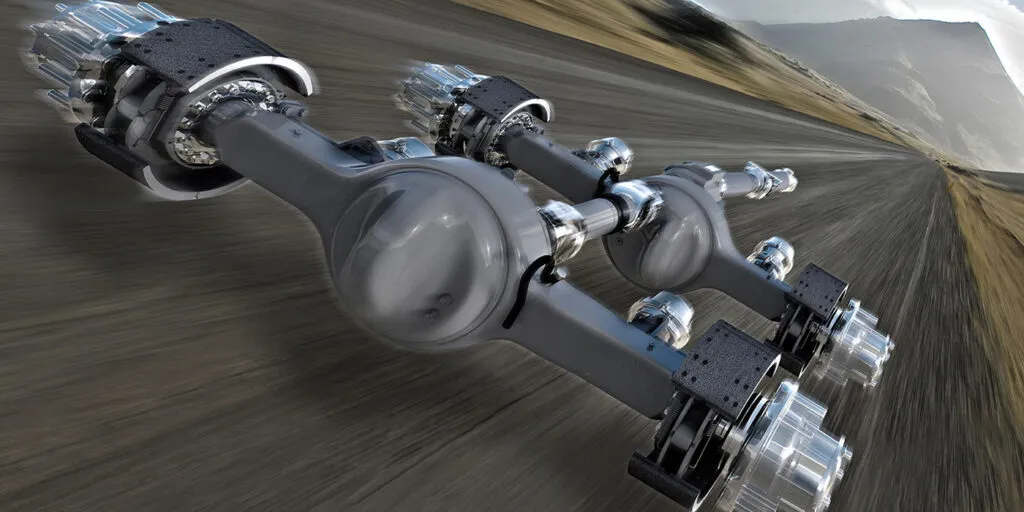
Table of Contents
The Foundation of Heavy-Duty Performance
For decades, the heavy-duty commercial vehicle industry has relied on two dominant players for its core drivetrain components: Meritor and Dana. Their axle systems form the backbone of transportation, enduring millions of miles under the most punishing conditions.
A. The Core Dilemma
When specifying a new truck or initiating a component replacement, the choice between a Meritor axle and a Dana axle is often the most debated. While both deliver industry-leading performance, subtle differences in design philosophy, technology, and maintenance requirements can drastically shift the economic equation for a fleet.
B. Brand Heritage and Market Position
- Meritor (The Rockwell Legacy): Tracing its lineage back to Rockwell International, Meritor stands as a global supplier specializing in drivetrain, braking, and aftermarket solutions. Meritor is often credited with pioneering weight-saving technologies and advanced lubrication systems for linehaul applications. Its primary focus is on delivering efficiency and reduced maintenance intervals.
- Dana (The Spicer Heritage): With the iconic Spicer® brand, Dana Incorporated possesses a comprehensive portfolio spanning the light-vehicle, commercial-vehicle, and off-highway sectors. Dana is widely respected for its robust gear designs, unparalleled legacy in drivetrain components, and strong presence in high-torque, severe-duty environments.
Meritor vs Dana Axle: Technical Specifications and Design Architecture

Axle specifications dictate performance. A detailed comparison of architecture, capacity, and efficiency technologies reveals where each brand gains a technical edge.
Axle Types and Application Coverage
Both manufacturers offer an extensive lineup, but their flagship series often defines their market positioning.
- Meritor Axles: Meritor’s portfolio is defined by the RT (Tandem) and RS (Single) series.
- Linehaul/Efficiency: RT-40/46 Series featuring single-reduction or tandem drive.
- Heavy-Duty/Severe Service: RZ-166/188 Series (double reduction) are favored in logging, mining, and construction, where maximum ground clearance and torque capacity are essential.
- Key Design Philosophy: Meritor frequently leverages its expertise in modularity and lightweight materials to improve payload and fuel economy without sacrificing strength.
- Dana Axles: Dana's offerings are consolidated under the highly recognized Spicer® brand, emphasizing robust reliability.
- Linehaul/Efficiency: The Spicer D-Series axles are widely used, offering a balance of efficiency and durability.
- Heavy-Duty/Vocational: Spicer 170/190 Series are built for high torque and rigorous duty cycles, often preferred in concrete mixers or oil field service.
- Key Design Philosophy: Dana focuses on optimized gear geometry and high-strength steel alloys to ensure maximum torque density and longevity under extreme loads.
Capacity Ratings and Torque Handling
The primary differentiator is the maximum capacity a specific axle is rated to handle.
- Gross Axle Weight Rating (GAWR): While equivalent models from both manufacturers often share similar GAWRs (e.g., 40,000 lbs, 46,000 lbs), subtle differences exist in their Maximum Input Torque (MIT) rating.
- Torque Endurance: Dana is historically recognized for its ability to handle higher transient peak torques, a crucial factor when paired with high-horsepower, automated manual transmissions (AMTs) in demanding acceleration scenarios. Meritor counters this with its advanced final-drive technologies designed for optimal efficiency throughout the torque curve.
Ratio Availability and Efficiency Technologies
Efficiency is the current battleground, measured primarily through gearing and reduced parasitic losses.
- Ratio Range: Both offer a comprehensive range of ratios from 2.28 to 7.17 or higher for double-reduction units. Dana often has a slightly wider array of ultra-fast ratios optimized for downspeeding strategies paired with modern engines.
- Fuel Efficiency Innovation:
- Meritor: Pioneered the Meritor FUELite™ tandem, focusing on lightweight components and advanced hypoid gear sets designed to minimize friction.
- Dana: Developed the Spicer® AdvanTEK™ axle, which utilizes highly optimized gear designs and proprietary low-viscosity lubricants to minimize spin losses, often yielding a verifiable fractional percentage point gain in fuel economy over traditional designs.
Design and Material Integrity
- Axle Housing Design: Meritor often employs fabricated, robotically welded housings, which can be lighter. Dana traditionally uses heavier-duty cast housings in many severe-duty applications, often favored for their inherent rigidity and ability to withstand extreme bending moments.
- Gear and Differential Components: Dana’s reputation stems from its Spicer gear metallurgy—specific heat-treat processes that result in superior surface hardness and core toughness. Meritor’s focus is on precision-ground gearing and advanced bearing technology to manage internal friction and heat.

Meritor vs Dana Axle: Durability and Real-World Performance
Durability is not just about survival; it is about predictable longevity and controlled failure points.
Expected Service Life and Common Failure Analysis
- Predictive Life: In similar linehaul environments, both axles generally exceed 1.2 million miles of service life when maintained strictly according to OEM specifications.
- Meritor Failure Points: Historical data suggests potential vulnerability in Inter-Axle Differential (IAD) clutches and specific pinion oil seals in older series. Newer models have largely mitigated these through enhanced seal designs (e.g., the MXL™ seal).
- Dana Failure Points: Dana components are robust, but issues may arise from improper bearing pre-load settings during service, leading to premature bearing failure. Dana’s widespread use often means repair experience is readily available, mitigating downtime risks.
Severe Condition Adaptation
- Temperature Extremes: Both utilize synthetic lubricants and sophisticated internal oil passages. Meritor’s Smart Flow™ technology aims for effective lubrication across all temperature ranges, while Dana emphasizes robust carrier assemblies to prevent distortion under high thermal load.
- Heavy Haul/Vocational Performance: Dana often has a light preference in ultra-heavy-duty applications (over 100,000 lbs GCW) due to its historically tougher housings and robust main-drive pinion bearing retention systems.
Drivetrain Integration and Compatibility
Axle performance is inextricably linked to the transmission and engine.
- Ecosystem Integration: Dana benefits from its own Spicer universal joint and driveshaft business, allowing for optimized, factory-balanced, and pre-integrated drivetrain packages. Meritor often partners closely with major OEM transmission suppliers like Eaton to ensure flawless electronic and mechanical integration.
- Electronic Control: Modern axles integrate with the truck’s Electronic Control Unit (ECU) for stability and traction control. Both offer robust sensor packages that communicate efficiently with Vehicle Stability Control (VSC) systems.
Manufacturer Warranty Policies
Warranty is the ultimate confidence indicator and a direct shield against unexpected TCO spikes.
| Key Warranty Metrics (Typical Linehaul) | Meritor (Example: Tandem Drive) | Dana (Example: AdvanTEK™ D-Series) |
| Standard Coverage | 3 years / 350,000 miles | 5 years / 500,000 miles (Often Standard) |
| Extended Options | Widely available through OEM programs | Best-in-class coverage available for premium models |
| Unique Feature | Meritor Extended Lube (MXL) components may offer lifetime coverage on non-wear parts. | Industry-leading Standard Warranty reflects high confidence in AdvanTEK™ durability. |
Conclusion on Durability: While Meritor focuses on weight reduction and lubrication innovation for efficiency, Dana often provides a more aggressive standard warranty for its flagship linehaul axles, suggesting a higher factory-level confidence in long-term component life.
Maintenance and Serviceability (Maintenance)
Maintenance is where the daily operational cost differences between the two brands become apparent.
Lubrication Requirements and Intervals
The push for extended service intervals is a key driver of modern axle design.
- Meritor Xtended Lube (MXL): Meritor’s MXL system dramatically extends drain intervals, often doubling or tripling traditional requirements when using approved synthetic gear oils (e.g., an interval of up to 500,000 miles). This is achieved through proprietary oil seals and advanced surface treatments.
- Dana Spicer 10 Series / AdvanTEK™: Dana utilizes high-performance synthetic gear lubes that also support extended intervals (often 500,000 miles or greater). Dana’s system is less reliant on unique seal technologies and more on its robust gear geometry to minimize lubricant degradation.
- Service Impact: Meritor’s specialized Permalube RPL (for U-joints) exemplifies a focus on "fit-and-forget" technology, a significant advantage for fleets seeking to eliminate routine maintenance stops.
Parts Availability and Repair Convenience
Downtime is a fleet operator’s worst enemy; parts accessibility is paramount.
- Parts Supply Chain: Both Meritor and Dana maintain extensive global aftermarket networks. However, Dana/Spicer components, due to their vast history and widespread use across multiple equipment types, often boast marginally greater local parts availability in remote or international locations.
- Repair Complexity: Meritor components, particularly its IAD units, can sometimes require specialized tools and more complex procedures for internal repairs. Dana’s standardized, robust design often makes it slightly easier for independent repair shops accustomed to traditional axle mechanics.
- Aftermarket Support: Both offer excellent online resources, but Dana's Spicer® Service App and detailed technical manuals are lauded by mechanics for their clarity and comprehensiveness.
Diagnostics and Technical Support
- Technical Documentation: Both companies provide digitized, searchable technical documentation, but Meritor is often recognized for its advanced Troubleshooting and Diagnostics Tools integrated with OEM service software.
- Training and Certification: Both operate comprehensive technician training programs. Fleets should ensure their in-house technicians are certified for the specific axle model (e.g., Meritor Tandem Axle Repair Certification).
The Economic Equation (Price Comparison)
The true cost is not the sticker price, but the Total Cost of Ownership (TCO) over the asset’s lifetime.
Initial Procurement Cost
- New Axles: Generally, new Meritor and Dana linehaul axles (e.g., 40,000 lbs tandem) are competitively priced and often fall within the same narrow price band when comparing equivalent specifications. Price variance is typically dictated by OEM volume discounts and specific advanced features (e.g., wide-base single tire compatibility).
- Aftermarket/Remanufactured: The remanufactured (REMAN) market for Dana is sometimes perceived as slightly more extensive, offering a competitive pricing edge for replacement units. Meritor’s Blue Horizon reman program is equally robust, but parts commonality can affect pricing.
Total Cost of Ownership (TCO) Analysis
TCO is the most critical metric, combining all costs over a five to ten-year period.

- Fuel Efficiency Impact ($C_{fuel}$): If a Dana AdvanTEK™ axle yields a 0.5% fuel economy improvement over 500,000 miles, this translates to thousands of dollars in savings, potentially overriding a cheaper initial purchase price.
- Maintenance Cost ($C_{maint}$): Meritor's extended lubrication intervals and MXL technologies can drastically reduce scheduled service labor and material costs, providing a competitive TCO advantage in high-mileage linehaul operations.
- Downtime Cost ($C_{downtime}$): Dana’s strong parts commonality can translate to faster, less expensive roadside repairs, directly minimizing the cost of unexpected downtime, which can be thousands of dollars per day.
Case Study Estimate (5-Year TCO for a Long-Haul Truck):
| Cost Factor | Meritor (MXL Tech) | Dana (AdvanTEK™) | TCO Driver |
| Initial Cost | $18,000 | $18,500 | Marginal difference |
| Fuel Efficiency | Good | Slightly better (0.5% adv.) | Dana advantage |
| Scheduled Maintenance | Lower (due to extended intervals) | Standard extended intervals | Meritor advantage |
| Warranty | Shorter standard term | Longer standard term | Dana advantage |
Component and Spare Parts Cost
While the initial price of an axle is similar, the cost of consumables over a decade adds up. Common Meritor parts like pinion seals and differential parts can sometimes be marginally more expensive than their high-volume Dana counterparts, reflecting Dana’s greater manufacturing scale in these specific components.
Summary and Decision Guide
The decision between Meritor and Dana is less about which one is "better" and more about which one is the optimal fit for the specific application and business model.
A. Comparative Strengths and Weaknesses
| Feature | Meritor Strengths | Dana Strengths |
| Efficiency/Weight | Superior due to lightweight housing and MXL tech | Excellent gear geometry for low spin losses |
| Durability | Strong performance in specialized double-reduction units | High shock-load resistance; very robust housing |
| Maintenance | Extended drain intervals (MXL); reduced labor costs | High parts commonality; widely known repair procedures |
| Warranty | Lifetime warranty options on specific components | Longer standard base warranty on many linehaul axles |
B. Targeted Recommendations
- Choose Meritor if: Your priority is maximizing fuel efficiency and minimizing scheduled maintenance labor through extended drain intervals and lightweight components. Ideal for high-mileage, dedicated linehaul operations.
- Choose Dana if: Your priority is long-term component assurance via superior warranty, maximum torque density, and reliable performance in mixed-service or vocational applications where shock loads are common. Ideal for construction, logging, and heavy specialized transport.
C. Final Expert Verdict
The selection must be integrated with the entire powertrain strategy. Fleet managers must collaborate with their OEMs and powertrain experts to model the TCO based on the specific gear ratio, engine torque, and anticipated route profile. Both Meritor and Dana represent the pinnacle of axle technology; the final choice is a strategic business decision, not a technical compromise.